Certified 24/7 emergency water damage extraction, structural cavity drying, fire and smoke restoration, licensed mold remediation, and discreet biohazard decontamination across McKinney and Collin County. Rapid mobile response staged along US-75 and SH-121 with guaranteed arrival in under 45 minutes.

Speak directly with an on-duty field supervisor. Immediate dispatch across North Texas in under 45 minutes.
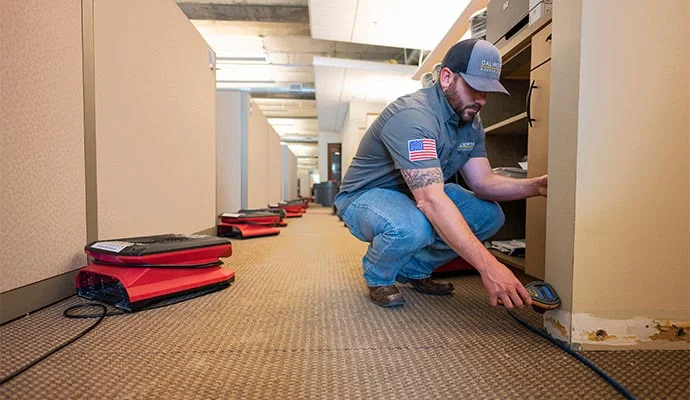
Immediate structural water extraction, thermal moisture mapping, fire soot removal, and certified mold remediation engineered specifically for McKinney historic properties, modern master-planned communities, and commercial districts.
McKinney, Texas serves as the historic county seat of Collin County and ranks consistently among the fastest-growing and most desirable residential communities in the United States. Spanning over 63 square miles approximately 32 miles north of downtown Dallas, McKinney is home to more than 210,000 residents. The city showcases a unique blend of architectural heritage and modern master-planned elegance. From the picturesque 19th-century Victorian and Craftsman residences surrounding Historic Downtown McKinney and Chestnut Square to the sprawling luxury lakefront estates of Stonebridge Ranch, the European-inspired architecture of Adriatica Village, the championship golf properties of Craig Ranch, and the newer developments of Tucker Hill and Trinity Falls along US-380, McKinney represents substantial structural investments.
However, property ownership in McKinney carries substantial disaster exposure driven by northern North Texas climatic volatility, local hydrographic basins, and severe soil dynamics. Geologically, McKinney rests directly upon the expansive Houston Black clay formation, widely known throughout the construction industry as "Texas Black Gumbo." This clay soil possesses an exceptionally high liquid limit and plasticity index, swelling violently during heavy seasonal rainstorms and desiccating into deep fissures during arid summer heat waves. The resulting soil volume changes generate thousands of pounds of upward foundation heave and differential settlement across concrete slab foundations. Over time, this movement fractures pressurized copper and PEX plumbing lines embedded beneath slabs and cracks underground PVC drain lines, resulting in hidden sub-slab water leaks that saturate foundation fill and warp hardwood flooring.
Furthermore, McKinney's hydrography presents acute stormwater hazards. The East Fork of the Trinity River, Wilson Creek watershed, Stiff Creek, and Franklin Branch traverse central and northern McKinney. Severe convective spring storm systems and supercells regularly track directly across the US-380 and Sam Rayburn Tollway corridors, generating torrential downpours exceeding 4 inches per hour. When municipal culverts along Highway 5 and University Drive become overwhelmed, low-lying properties, sunken garages, and historic crawl spaces experience rapid surface flash flooding. Surface storm runoff introduces silt, lawn chemicals, and microbial contaminants across foundation weep holes, requiring Category 3 extraction and hospital-grade sanitization.
In the winter months, McKinney is among the first communities in the Dallas-Fort Worth metroplex to experience sub-freezing Arctic cold fronts sweeping south across the open North Texas plains. Temperatures frequently plunge into the low teens, freezing uninsulated domestic water supply lines and fire sprinkler pipes routed through unconditioned attics, exterior soffits, and garage ceilings. Because water expands by 9% upon freezing, hydrostatic pressure trapped between ice blockages and closed fixtures climbs beyond 2,000 PSI, rupturing copper, CPVC, and PEX piping. When warmer daytime temperatures thaw the line, hundreds of gallons of pressurized water deluge ceiling drywall, blown insulation, and subfloor assemblies within minutes.
When disaster strikes your McKinney property, rapid intervention is essential to prevent permanent structural rot and toxic mold amplification. Restore Crest maintains dedicated, fully equipped emergency disaster response units staged along US-75 (Central Expressway) and SH-121 (Sam Rayburn Tollway). Operating from our regional disaster response center at 1910 Pacific Ave, Dallas, TX 75201, our certified mobile extraction and structural drying crews reach any address across McKinney within an average arrival window of under 45 minutes, 24 hours a day, 365 days a year. Every project is executed with 100% upfront flat-rate itemized estimates and absolute pricing transparency.
Understanding how Collin County soil mechanics, Wilson Creek flood basins, and severe North Texas storms trigger structural property losses across McKinney.
McKinney is underlain by the expansive Houston Black clay series, notorious for dramatic shrink-swell cycles. In hot Texas summers, the clay pulls away from residential foundation grade beams, causing perimeter settling and interior slab upward deflection. Pressurized copper domestic supply lines embedded beneath post-tension slabs experience severe shear stress at elbows and manifolds, producing pinhole slab leaks that pump hot or cold water invisibly beneath flooring. Saturated concrete slabs wick moisture upward into expensive hardwood floors and carpet padding, elevating indoor humidity and fostering mold growth behind baseboards. Explore our specialized slab leak water damage detection and drying.
The Wilson Creek watershed flows eastward across central McKinney toward Lake Lavon, collecting drainage from Stonebridge Ranch, Towne Lake, and Eldorado Parkway. During severe convective spring supercells, sudden deluges drop multiple inches of rain within an hour, causing Wilson Creek and Stiff Creek to exceed their banks. Saturated ground conditions force stormwater through exterior brick weep holes, subterranean crawlspaces, and basement utility rooms. Floodwater carrying organic soil contaminants and biological bacteria constitutes Category 3 blackwater, requiring immediate extraction and EPA-registered antimicrobial disinfection. Review our emergency water damage restoration protocols.
Historic homes in Downtown McKinney, Chestnut Square, and the Finch Park neighborhood were constructed with classic pier-and-beam foundations. Open foundation vents allow humid Collin County air to enter crawl spaces and condense on cooler wood subfloor joists. Over time, chronic subterranean dampness causes wood-rot fungi, cupping antique pine and oak floors, and structural joist sagging. Restore Crest provides specialized standing water pumping, fungal timber scrubbing, and engineered 20-mil vapor barrier encapsulation systems with commercial crawlspace dehumidification. Explore our crawl space encapsulation services.
Certified industrial mitigation protocols tailored to McKinney residential estates, historic properties, multi-family communities, and commercial centers.
Water intrusion from ruptured water heaters, frozen attic pipes, or appliance line breaks requires immediate intervention. Restore Crest deploys truck-mounted vacuum extractors generating massive airflow, paired with weighted extraction rovers to draw water out of saturated carpet pads and concrete subfloors. We follow with FLIR thermal cameras, moisture mapping, and psychrometric LGR dehumidification arrays to dry enclosed wall cavities without unnecessary demolition.
McKinney homes feature custom solid hardwood, engineered plank, and historic tongue-and-groove flooring. When saturated, wood floorboards cup and crown rapidly. Restore Crest utilizes specialized negative-pressure injectidry vacuum drying mats that draw trapped water directly through wood pores and out of subflooring, reversing cupping and preserving irreplaceable hardwood floors without costly replacement.
The warm, humid North Texas climate creates prime conditions for toxic mold propagation following plumbing leaks or crawl space dampness. In accordance with Texas Department of Licensing and Regulation (TDLR) guidelines, our certified technicians establish negative-pressure containment barriers using true HEPA air filtration. We physically remove fungal colonies, apply EPA-registered biostatic antimicrobials, and prepare properties for third-party post-remediation clearance testing.
Kitchen fires, electrical blazes, or chimney flare-ups deposit acidic soot residues and volatile smoke particulates throughout drywall, ceiling framing, and HVAC ductwork. Our McKinney fire restoration crews perform comprehensive soot containment, ultrasonic contents cleaning, dry chemical sponge wiping, and industrial thermal fogging or atmospheric hydroxyl gas treatments to permanently destroy smoke odors at the molecular level.
Municipal sanitary sewer main blockages, toilet overflows, and trauma scene emergencies represent dangerous Category 3 biohazards carrying pathogens like E. coli, Hepatitis B, and Salmonella. Our OSHA-compliant decontamination teams arrive in completely unmarked service vehicles for absolute privacy. We extract contaminated bio-fluids, sanitize porous materials with hospital-grade virucides, and verify sanitary cleanliness with ATP bioluminescence testing.
McKinney is home to medical centers, corporate offices, public schools, and retail complexes that require large-loss disaster capabilities. Restore Crest operates industrial trailer-mounted desiccant dehumidifiers, high-capacity mobile electrical power generators, and large-diameter containment ducting. We handle multi-floor sprinkler discharges, commercial roof leaks, and warehouse floods with targeted staging to minimize business downtime.
Executing ANSI/IICRC S500 and S520 industry standards to ensure fast, safe, and verifiable property recovery.
Within 45 minutes of dispatch, our IICRC Master Restorer arrives on site. We deploy FLIR high-resolution thermal imaging cameras and penetrative digital moisture meters to trace hidden moisture pathways inside wall cavities, ceiling assemblies, and under subfloors without destructive wall openings.
Removing physical liquid is 1,200 times faster and more efficient than evaporation. We deploy truck-mounted vacuum extractors, submersible trash pumps, and weighted sub-surface extraction mats to draw out standing water from carpet pads, porcelain tile grout, and hardwood seams.
To stop cross-contamination, we seal affected zones with zippered polyethylene containment barriers under negative air pressure. We apply EPA-registered botanical antimicrobials (thymol formulations) to exposed studs, subfloors, and concrete to halt microbial development immediately.
We position commercial Low Grain Refrigerant (LGR) dehumidifiers and high-velocity axial air movers using psychrometric science. By establishing a low vapor pressure differential, moisture trapped within deep timber framing and subfloor assemblies is pulled into the air stream and condensed out.
Our IICRC-certified technicians visit the property daily to measure relative humidity (RH), ambient temperature, Grains Per Pound (GPP), and material moisture content. We adjust equipment positioning dynamically until structural materials reach their historical dry standards.
Once dry standards are certified with thermal and penetrative diagnostics, we perform final HEPA vacuuming and deliver a comprehensive Structural Drying Certificate. For biohazard or mold projects, third-party clearance ensures the property is safe for immediate re-occupancy.
Critical immediate actions every McKinney homeowner and facility director should take during an active indoor flooding catastrophe.
In McKinney, the primary municipal water shutoff is located near the front street curb or lawn sidewalk in an iron or concrete ground box marked "WATER". Remove the box lid with a screwdriver or meter key. Inside, locate the brass curb stop valve positioned on the street side before the digital meter. Using a standard T-handle water meter key, rotate the brass valve 90 degrees clockwise until the eyelet aligns perpendicularly across the pipe line. This terminates all incoming pressurized municipal water to the building.
Many McKinney homes in subdivisions like Stonebridge Ranch, Craig Ranch, and Tucker Hill feature an interior ball valve shutoff inside the garage, adjacent to the water heater, or inside a laundry utility cabinet. Locate the incoming copper or PEX supply line entering through the slab, grip the lever handle, and turn it one quarter turn so the handle sits at a 90-degree right angle to the pipe. This terminates supply lines without going outdoors.
If the street curb stop is seized, buried beneath landscape mulch, or leaking heavily, contact the City of McKinney Water Utilities Department emergency dispatch line at (972) 547-7360 immediately. While city utility technicians are en route, contact Restore Crest at +1 (214) 491-5611 to stage extraction equipment and begin moisture containment immediately.
Setting the industry standard for fast mobilization, scientific drying, and total billing transparency across Collin County.
With rapid response rigs positioned right along US-75 and SH-121, our fully stocked units arrive at your McKinney home or commercial facility in under 45 minutes, ready to begin immediate water extraction.
We believe in complete pricing transparency. Our on-duty field supervisor conducts an exhaustive thermal assessment and presents an itemized, line-by-line written proposal before any machinery is activated. Zero surprises.
We invest in advanced negative-pressure injectidry hardwood floor systems, specialty cavity injection manifolds, and desiccant dryers that salvage expensive hardwood flooring and custom cabinets without costly replacement.
For sensitive biohazard remediation, raw sewage overflows, or estate cleanouts in private residential neighborhoods like Stonebridge Ranch or Craig Ranch, our crews operate with complete confidentiality in unmarked service vehicles.
Documented emergency mitigation outcomes demonstrating our scientific psychrometric drying, material salvage, and crawl space structural recovery.
Initial Challenge: During a prolonged sub-zero North Texas freeze event, an uninsulated 1-inch PEX domestic supply line located inside an attic knee wall ruptured in a 5,400 sq. ft. Stonebridge Ranch residence. Approximately 2,800 gallons of pressurized water collapsed 400 square feet of ceiling drywall in the great room, soaking blown insulation and saturating 1,600 square feet of hand-scraped black walnut hardwood flooring.
Action Taken: Restore Crest deployed mobile mitigation units, arriving in 34 minutes. Technicians performed immediate water extraction, removed wet drywall and insulation under negative-pressure containment, and installed commercial injectidry floor drying panels directly over the walnut floor seams. High-capacity Low Grain Refrigerant dehumidifiers and heated airflow units were deployed to extract subfloor moisture.
Verified Outcome: The custom walnut flooring achieved full dry standard equilibrium (EMC 8.2%) within 5 days without cupping, crowning, or structural delamination. The floor was completely preserved without replacement, saving the homeowners over $42,000 in custom hardwood replacement and refinishing costs. Review our specialized hardwood floor water extraction services.
Initial Challenge: Severe convective rainfall overwhelmed local surface drainage near Chestnut Square, causing 8 inches of muddy stormwater to flood the pier-and-beam crawlspace of a restored 1912 Craftsman home. Saturated soil conditions and poor ventilation led to extensive fungal amplification across pine floor joists and caused antique heart-pine living room flooring to buckle.
Action Taken: Restore Crest staged submersible trash pumps and extracted over 4,500 gallons of standing muddy water from the crawl space within hours. Technicians hand-scraped contaminated soil, applied EPA-registered botanical antimicrobials across structural floor joists, and installed an engineered 20-mil reinforced antimicrobial vapor barrier sealed tightly to foundation perimeter piers with a commercial crawlspace dehumidifier.
Verified Outcome: Subfloor joist moisture dropped from 28% to 10.5% within 6 days. The historic heart-pine flooring settled back to flat equilibrium without replacement. Third-party clearance testing confirmed sterile indoor air quality, permanently protecting the historic home from foundation wood rot. Explore our crawl space encapsulation services.
Mobile emergency disaster recovery units stationed strategically throughout McKinney for under 45-minute dispatch.
ZIP Codes: 75070, 75072
ZIP Codes: 75070
ZIP Codes: 75069
ZIP Codes: 75071
We eliminate financial anxiety with guaranteed line-item pricing before any equipment is powered on. Direct billing with zero surprise surcharges.
Comprehensive FLIR thermal imaging moisture inspection, diagnostic moisture mapping, standing water vacuum extraction, and immediate microbial containment application.
Complete multi-day psychrometric drying package utilizing commercial LGR dehumidifiers, high-velocity axial air movers, cavity weep venting, and daily digital moisture tracking.
Engineered remediation for historic pier-and-beam crawlspaces, commercial roof floods, full-building mold abating under negative air, or sewage decontamination.
All work is backed by our 100% upfront flat-rate itemized guarantee. We accept all major credit cards, bank wire transfers, and commercial purchase orders. Zero hidden travel fees.
"Whether addressing a luxury lakefront estate in Stonebridge Ranch or preserving historic tongue-and-groove framing in Downtown McKinney, our field protocols are driven by psychrometric science and rigorous standards. We trace moisture paths with precision thermal FLIR imaging, reverse hardwood cupping with vacuum injection drying, and deliver certified dry standards with 100% upfront flat-rate itemized clarity."
Clear, direct answers regarding emergency response times, upfront flat rates, structural drying, and safety procedures.
Restore Crest maintains dedicated emergency mitigation vehicles staged directly along US-75 (Central Expressway) and SH-121 (Sam Rayburn Tollway) in Collin County. We reach any address in McKinney — from Stonebridge Ranch and Craig Ranch to Historic Downtown and Trinity Falls — in under 45 minutes on average, 24 hours a day, 7 days a week, 365 days a year.
Yes. When mitigation starts within the first 24 to 48 hours, we frequently rescue solid, engineered, and historic tongue-and-groove hardwood floors using specialized negative-pressure injectidry vacuum drying mats. These mats seal against the floorboards and pull deep subfloor moisture upward through wood pores, reversing cupping and saving property owners thousands of dollars in hardwood replacement costs. Explore our hardwood floor drying service.
For historic pier-and-beam foundations in Downtown McKinney, we deploy submersible trash pumps to remove standing water, apply EPA-registered botanical antimicrobials across floor joists, and install engineered 20-mil antimicrobial vapor barrier encapsulation systems with dedicated commercial crawlspace dehumidifiers to permanently prevent mold and foundation wood rot. Review our crawl space encapsulation services.
In the warm, humid climate of North Texas, mold spores actively germinate on wet drywall paper, baseboard backing, and subfloor plywood within 24 to 48 hours of initial moisture exposure. That is why immediate water extraction, rapid cavity venting, and EPA-registered antimicrobial washdown are essential during the initial emergency response. Discover our mold remediation protocols.
On most McKinney properties, your primary water shutoff valve is located inside the City of McKinney water meter box, near the street curb or front sidewalk in an iron or concrete box marked "WATER". Remove the lid, locate the brass curb stop valve before the digital meter, and rotate it 90 degrees clockwise with a water meter key until the eyelet aligns across the pipe. Inside the home, secondary emergency shutoff valves are typically found in the garage or near the water heater.
We believe in complete pricing transparency. When our lead field supervisor arrives at your McKinney property, we conduct a comprehensive thermal imaging inspection to identify the exact scope of moisture. You receive an itemized, line-item written estimate before any equipment is powered on. You approve every specific charge in advance. We never bill open-ended hourly rates or add unexpected dispatch surcharges. Direct payment is accepted via major credit cards, bank wire, or commercial purchase orders.
We deploy non-destructive diagnostic tools including FLIR high-resolution thermal imaging cameras, radio-frequency non-penetrating moisture meters, and acoustic pipe detection instruments. These tools identify evaporative cooling patterns and pinpoint hidden sub-slab plumbing leaks without jackhammering intact flooring or breaking custom ceramic tile. Explore our slab leak drying services.
Every disaster recovery project undertaken by Restore Crest in McKinney is supervised by an on-duty field lead holding Master-level certifications from the Institute of Inspection, Cleaning and Restoration Certification (IICRC). Our credentials include Master Water Restorer (MWR), Applied Microbial Remediation Technician (AMRT), Fire & Smoke Restoration Technician (FSRT), and Applied Structural Drying (ASD). All work strictly conforms to ANSI/IICRC S500 water and S520 mold standards.
A sanitary sewer backup is an acute Category 3 biohazard containing harmful bacteria and viral pathogens. Evacuate occupants and pets from the affected areas immediately. Do not attempt to clean sewage with household shop vacuums or bleach. Turn off HVAC air handlers to prevent airborne contamination. Call Restore Crest immediately at (214) 491-5611 for emergency containment, antimicrobial extraction, and hospital-grade decontamination. Review our sewage backup cleanup services.
Under scientific psychrometric drying protocols utilizing commercial LGR dehumidifiers and high-velocity air movers, standard drywall, baseboards, and wood framing achieve dry standard equilibrium within 3 to 5 days. Denser materials such as hardwood flooring, multiple subfloor layers, or crawl space framing may require 5 to 7 days of controlled drying. Our technicians take daily digital readings to certify complete dry standard before equipment is demobilized.
Restore Crest provides specialized disaster mitigation throughout the entire Dallas-Fort Worth metroplex. Explore our dedicated service divisions and adjacent municipal service corridors:
Speak directly with an on-duty field supervisor. Our certified mobile extraction and structural drying crews are stationed across Collin County, arriving at your McKinney doorstep in under 45 minutes with upfront flat-rate pricing.