Certified 24/7 emergency water damage extraction, structural cavity drying, fire and smoke restoration, licensed mold remediation, and discreet biohazard decontamination across Fort Worth and Tarrant County. Rapid mobile response staged along I-30 and I-35W with guaranteed arrival in under 45 minutes.

Speak directly with an on-duty field supervisor. Immediate dispatch across North Texas in under 45 minutes.
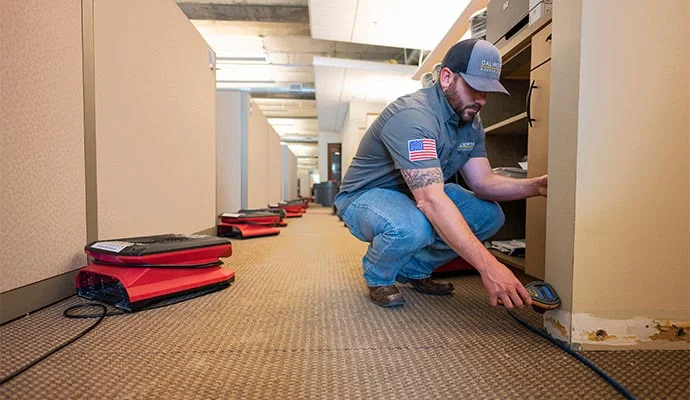
Immediate structural water extraction, thermal moisture mapping, and complete environmental decontamination engineered specifically for Fort Worth residential estates, historic properties, and industrial complexes.
Fort Worth, Texas stands as the historical, cultural, and industrial anchor of the western Dallas-Fort Worth metroplex. Encompassing more than 350 square miles across Tarrant, Denton, and Parker counties, Fort Worth is home to over 960,000 residents and ranks as the 13th-largest city in the United States. From the vibrant urban core of Downtown Sundance Square and the commercial high-rises along West 7th Street to the historic residential districts of Near Southside, Fairmount, and Ryan Place, Fort Worth showcases an extraordinary spectrum of architecture. The city's neighborhoods span classic 1920s Craftsman bungalows, post-war mid-century masonry homes, affluent custom estates in Mira Vista and Tanglewood, and massive high-tech industrial logistics facilities throughout the Alliance Corridor.
However, Fort Worth's geographic positioning along the Clear Fork and West Fork of the Trinity River exposes local properties to severe climatic and structural disaster hazards. During North Texas spring convective weather cycles, violent supercell storms track east along the Interstate 30 and Highway 121 corridors, bringing torrential flash floods, straight-line winds exceeding 75 MPH, and golf-ball-sized hail that breaches residential roof membranes and overwhelms municipal storm drainage. In the winter, sudden arctic polar fronts plunge temperatures far below freezing, causing unprotected water pipes in unconditioned attics and crawlspaces to freeze, expand, and rupture violently.
Geotechnically, Fort Worth properties contend with complex ground conditions ranging from dense, reactive Eagle Ford and Houston Black clay formations to shallow limestone shelves and alluvial riverbed silt deposits. As seasonal rainfall fluctuates between torrential floods and blistering summer droughts, uneven foundation settlement exerts continuous rotational stress on concrete slabs and crawlspace framing. These structural movements regularly shear subterranean copper plumbing lines, crack municipal sewer laterals, and lead to catastrophic hidden slab leaks beneath luxury homes.
When sudden disaster strikes your Fort Worth property, immediate professional response is critical to prevent permanent structural loss. Saturated gypsum drywall dissolves within hours, structural floor framing warps, and toxic mold spores establish active colonies within 24 to 48 hours. Operating from our central logistics center at 1910 Pacific Ave, Dallas, TX 75201, Restore Crest maintains dedicated, fully equipped emergency disaster recovery units staged continuously along the primary transit routes of Tarrant County, including I-30, I-35W, and the Chisholm Trail Parkway. Our IICRC-certified Master Restorers guarantee on-site arrival in under 45 minutes across every Fort Worth neighborhood, 24 hours a day, 365 days a year. View verified client reviews on our customer reviews and testimonials page.
Mobile emergency response units equipped with industrial truck-mounted vacuum extractors, negative air scrubbers, and scientific psychrometric drying technology.
From high-pressure plumbing ruptures and Trinity River flash flooding to second-floor bathroom overflows, our certified crews deploy high-CFM truck-mounted extractors, weighted sub-surface carpet wands, and injectidry floor systems to rescue hardwood floors, crawlspaces, and concrete slabs without demolition.
Kitchen grease flare-ups, electrical panel fires, and structural blazes leave acidic soot deposits that corrode wiring and discolor historic plaster walls. We execute chemical sponge soot removal, thermal fogging, and molecular atmospheric hydroxyl treatments to eliminate stubborn smoke odors at the source.
Fort Worth's damp river valleys and humid summer temperatures cause extensive condensation inside pier-and-beam crawlspaces, attics, and AC ductwork. We erect airtight 6-mil poly containment barriers, maintain continuous negative air pressure with certified HEPA scrubbers, and apply botanical biocides to eradicate black mold.
Municipal mainline sewage backflows, commercial grease trap blowouts, and traumatic biological incidents involve severe infectious pathogens including E. coli and Salmonella. Arriving in completely unmarked vehicles for total homeowner privacy, our OSHA-certified technicians execute clinical biohazard extraction and ATP clearance.
Analyzing the engineering interactions between expansive Blackland clay, historic pier-and-beam crawlspaces, and modern post-tension slabs.
Fort Worth presents one of the most structurally diverse architectural landscapes in North Texas. In historic central neighborhoods like Fairmount, Ryan Place, and Arlington Heights, thousands of residential homes are constructed on traditional raised pier-and-beam foundations. Beneath these structures lie unconditioned crawlspaces exposed to high groundwater tables along the Trinity River basin. In contrast, post-1970s master-planned developments in Mira Vista, Tanglewood, Ridglea Hills, and North Fort Worth rely predominantly on post-tension concrete slabs built upon dense Eagle Ford shale and expansive Blackland clay formations.
In historic Fort Worth neighborhoods, torrential storms frequently cause groundwater to pool inside crawlspace depressions beneath historic tongue-and-groove hardwood floors. Saturated dirt floors evaporate moisture directly upward into structural floor joists, rotting sills and cultivating widespread mold colonies. If your floors feel bouncy or your home smells musty, consult our specialized Fort Worth crawlspace water extraction team and engineered crawl space encapsulation service.
In modern post-tension slab homes throughout Southwest and North Fort Worth, the dramatic expansion and contraction of Tarrant County's clay soils exerts immense upward and lateral pressure against foundation concrete. Copper water supply lines routed beneath the slab experience intense mechanical shearing, resulting in catastrophic sub-slab ruptures that saturate foundation soil and pump water upward through tile grout and luxury vinyl planks. Learn about our non-invasive slab leak drying service.
During North Texas winter polar cold snaps, freezing arctic winds funneled through uninsulated attic soffits and crawlspace foundation vents rapidly freeze domestic water supply lines. The resulting radial ice pressure splits copper pipes and PEX fittings. When temperatures thaw, pressurized water deluges through ceilings, causing catastrophic structural collapse. Review our specialized burst pipe cleanup protocol.
By combining building science with decades of localized disaster mitigation experience across Tarrant County, Restore Crest deploys specialized drying protocols that protect Fort Worth's architectural heritage while eliminating secondary microbial colonization.
Essential immediate steps and municipal utility shutoff guidance to safeguard your property and prevent catastrophic structural loss before our response team arrives.
Locate your municipal water meter box near the street curb or front lawn sidewalk, typically housed inside a heavy cast-iron or composite ground vault marked "WATER". Remove the lid with a large screwdriver, locate the brass curb stop valve before the digital meter, and rotate it a quarter turn clockwise using a standard five-way meter key until the valve eyelet aligns with the pipe.
If flood water is spreading across baseboard outlets or leaking through ceiling drywall near chandeliers and recessed light cans, NEVER walk through standing water. Locate your main electrical service panel (typically inside the garage or exterior brick wall) and trip the individual circuit breakers supplying wet zones, or shut off the main service disconnect switch.
If overhead water from an upstairs pipe break has created a sagging, discolored water blister on ceiling drywall, position plastic storage tubs directly beneath the sag. Pierce the center of the blister using a screwdriver or broom handle to establish controlled drainage, preventing the entire saturated drywall sheet from collapsing under water weight. Review our ceiling water repair service.
NEVER attempt to extract category 2 grey water or category 3 raw sewage with a household shop vacuum; consumer vacuums lack sealed HEPA filtration and will atomize millions of live bacterial pathogens into your family's breathing air. DO NOT attempt to dry saturated hardwood floors with residential box fans, which only dries surface wood and causes severe permanent cupping.
Rapid mobile staging corridors, immediate communication with an active field operations supervisor, and industrial extraction deployment.
When an emergency water leak or fire event strikes your Fort Worth property, response time is the single greatest determinant of whether structural materials can be scientifically salvaged or must be demolished. At Restore Crest, our emergency response system is engineered for rapid mobilization. When you contact our 24/7 hotline at +1 (214) 491-5611, you speak directly with an on-duty field supervisor within 15 seconds, eliminating call center delays.
Operating from our regional headquarters at 1910 Pacific Ave, Dallas, TX 75201, Restore Crest maintains dedicated mobile disaster recovery units stationed along the primary transportation corridors serving Fort Worth and Tarrant County:
Provides direct, high-speed east-west transit connecting our fleet directly into Downtown Fort Worth, Sundance Square, the Cultural District, and Arlington Heights within 32 to 38 minutes.
Direct north-south arterial serving Near Southside medical facilities, TCU campus residential areas, and expanding commercial logistics parks in North Fort Worth and the Alliance Corridor.
Enables our certified response teams to navigate Tarrant County rapidly, ensuring under 40-minute arrival to luxury residential enclaves in Mira Vista, Overton Park, and Walsh Ranch.
Upon arrival at your property, our field supervisor immediately performs high-resolution FLIR thermal camera diagnostics, maps the boundary of hidden moisture migration behind walls and underneath floorboards, and provides you with a transparent, itemized flat-rate quote. Once authorized, our crew initiates high-volume water extraction and structural drying immediately. Learn more about our company mission and certified leadership on our about Restore Crest page.
Master-level technical expertise, specialized preservation technology, and 100% upfront flat-rate pricing with zero hidden fees.
Every emergency project in Fort Worth is directed by an on-duty supervisor holding elite IICRC Master Water Restorer (MWR), Applied Microbial Remediation Technician (AMRT), and Applied Structural Drying (ASD) credentials.
We believe in complete financial transparency. You receive a detailed, line-item written estimate before any equipment begins running. No open-ended hourly fees, no surprise dispatch costs, and zero hidden billing.
We invest in specialized negative-pressure injectidry hardwood floor mats, desiccant airflow dryers, and non-invasive moisture meters designed to salvage historic tongue-and-groove flooring and custom cabinetry without demolition.
For sensitive biohazard remediation, raw sewage backups, or estate cleanouts in private communities like Mira Vista and Montserrat, our crews arrive in completely unmarked service vehicles for total personal privacy.
Documented emergency mitigation outcomes demonstrating our scientific psychrometric drying, material salvage, and rapid commercial response.
Initial Challenge: A pressurized 1-inch copper main supply line suffered a pinhole fracture beneath the concrete post-tension slab of a 6,500 sq. ft. Mira Vista estate. Trapped water saturated 1,500 square feet of sub-slab fill, warming imported Italian porcelain tiles and wicking into custom walnut baseboards across three adjoining rooms.
Action Taken: Restore Crest arrived on site in 38 minutes. Technicians utilized FLIR thermal imaging and acoustic line detectors to pinpoint the underground leak without jackhammering intact tile. After plumbing rerouting, our team established negative-pressure cavity drying manifolds along perimeter baseboards paired with high-capacity Low Grain Refrigerant dehumidifiers.
Verified Outcome: All sub-slab moisture and concrete framing achieved full dry equilibrium within 5 days. Zero custom Italian porcelain floor tiles were broken or removed, preserving the homeowner's architectural investment and saving an estimated $32,000 in demolition and tile replacement costs. Review our slab leak drying service.
Initial Challenge: An acoustic ceiling commercial fire sprinkler head fractured on the fourth floor of a boutique hotel near Sundance Square, discharging approximately 55 gallons per minute of black, rust-filled cutting oil water across three guest floors and down the central elevator chase.
Action Taken: Restore Crest deployed our large-loss commercial mitigation fleet within 34 minutes. Technicians contained elevator corridors with zip-wall poly containment, operated truck-mounted vacuum extractors across 6,500 square feet of commercial hallway carpeting, and ducted trailer-mounted desiccant dehumidifiers directly into the floor cavities and elevator pit.
Verified Outcome: Saturated elevator pit machinery was pumped and decontaminated, while guest suites and drywall cavities were completely dried and certified sanitary within 52 hours. The hotel reopened all affected guest suites with zero business interruption over the weekend. Explore our elevator pit water extraction service.
Mobile disaster recovery teams stationed throughout Tarrant County for guaranteed under 45-minute dispatch.
ZIP Codes: 76102, 76107
ZIP Codes: 76109, 76132
ZIP Codes: 76104, 76110
ZIP Codes: 76177, 76244
Clear, itemized line-item written estimates delivered before any equipment starts. You maintain total financial control with zero unexpected billing.
"Whether extracting sudden floodwaters in the Cultural District or mitigating sewage backups in Sundance Square, our emergency operations are backed by 20+ years of Master Restorer expertise. We deploy industrial desiccant drying technology and provide 100% upfront flat-rate itemized estimates with zero surprises."
Authoritative technical answers to the most common voice search and emergency disaster questions from Fort Worth property owners.
Restore Crest guarantees an on-site arrival time of under 45 minutes across every Fort Worth neighborhood. Our mobile extraction units maintain continuous 24/7 staging along Interstate 30, Interstate 35W, and the Chisholm Trail Parkway. Whether your property is located in Downtown Sundance Square, the Cultural District, TCU / Tanglewood, Mira Vista, or North Fort Worth, an on-duty field supervisor is dispatched within minutes of your call to +1 (214) 491-5611.
Historic homes built throughout Fort Worth's Near Southside rely on pier-and-beam foundations constructed over expansive clay and alluvial soils near the Trinity River basin. In humid weather and heavy rainstorms, groundwater accumulates beneath the home, evaporating into subfloor joists and tongue-and-groove flooring. Without proper vapor barriers, structural joists rot and mold colonies flourish. Restore Crest installs engineered 20-mil vapor barriers and commercial crawlspace dehumidifiers to protect historic homes permanently. Review our crawl space encapsulation guide.
Yes, in most clean and grey water plumbing leaks, custom hardwood floors can be completely salvaged if mitigation begins within 24 to 48 hours. Restore Crest utilizes specialized negative-pressure injectidry vacuum floor mats that seal directly over cupping hardwood planks. High-vacuum suction pulls trapped moisture vertically out of the subfloor wood fibers, while low-grain refrigerant dehumidifiers extract evaporated vapor from the ambient air, completely flattening warped boards and eliminating the need for expensive floor replacement. See our hardwood floor drying protocol.
In Tarrant County's humid microclimate, dormant mold spores (such as Aspergillus, Penicillium, and Stachybotrys) begin active germination within 24 to 48 hours of contact with moist cellulose materials like drywall paper, baseboard wood, and carpet padding. If extraction and mechanical dehumidification do not commence immediately, fungal colonization spreads rapidly within wall cavities and HVAC ductwork. If you notice a persistent musty odor, consult our certified Fort Worth mold remediation specialists.
On most Fort Worth properties, your primary emergency shutoff is inside the City of Fort Worth water meter box, located near the street curb or front lawn sidewalk inside a rectangular cast-iron or composite ground vault marked "WATER". Remove the vault lid, locate the brass curb stop valve before the digital meter, and rotate it a quarter turn clockwise using a standard meter key until the valve eyelet aligns with the pipe. Inside the home, secondary emergency shutoffs are typically found near the water heater in the garage or inside a dedicated utility closet.
We believe in complete pricing transparency. When our lead field supervisor arrives at your Fort Worth property, we conduct a comprehensive thermal imaging inspection to identify the exact perimeter of moisture and structural impact. You receive an itemized, line-item written estimate before any equipment is powered on. You approve every specific charge in advance. We never bill open-ended hourly rates or add unexpected emergency dispatch surcharges. Direct payment is accepted via major credit cards, bank wire, or commercial invoicing.
Yes, Restore Crest operates a dedicated large-loss commercial restoration fleet equipped with industrial high-volume water extraction extractors, trailer-mounted desiccant dehumidifiers, and HEPA air scrubbers. We frequently service corporate campuses, high-rise office towers, retail centers, and medical facilities throughout Downtown Fort Worth, West 7th, and the Alliance Corridor, focusing on rapid business continuity and minimal operational downtime. Discover our commercial water damage services.
Every project undertaken by Restore Crest in Fort Worth is directed by an on-duty field supervisor holding Master-level certifications from the Institute of Inspection, Cleaning and Restoration Certification (IICRC). Our credentials include Master Water Restorer (MWR), Applied Microbial Remediation Technician (AMRT), Fire & Smoke Restoration Technician (FSRT), and Applied Structural Drying (ASD). All work strictly conforms to ANSI/IICRC S500 water standards and S520 mold standards.
Restore Crest provides specialized disaster mitigation throughout the entire Dallas-Fort Worth metroplex. Explore our dedicated service divisions and adjacent municipal service corridors:
Speak directly with an on-duty field supervisor. Our certified mobile extraction and structural drying crews are stationed across Tarrant County, arriving at your Fort Worth doorstep in under 45 minutes with upfront flat-rate pricing.