When pressurized plumbing failures, appliance overflows, or foundation intrusions submerge custom hardwood flooring, rapid scientific intervention is the difference between complete preservation and devastating tear-out demolition. Restore Crest deploys commercial negative-pressure vacuum injection mat systems, deep hammer-probe moisture diagnostics, and industrial desiccant dehumidifiers across Dallas, Highland Park, University Park, Preston Hollow, and Lakewood within 45 minutes to draw trapped water from subfloors, reverse cupping, and preserve original oak, walnut, and engineered hardwoods in place.

Speak directly with an on-duty field supervisor. Immediate dispatch across North Texas in under 45 minutes.
Understanding how moisture interacts with natural wood cell walls is essential for non-destructive drying without structural distortion.
Hardwood flooring is not an inert manufactured composite; it is an active, hygroscopic organic material composed of vascular bundles, cellulose microfibrils, hemicellulose, and lignin. Across Dallas residences—from historic quarter-sawn white oak estates in Highland Park to wide-plank black walnut installations in Preston Hollow and modern French oak engineered planks in Turtle Creek high-rises—hardwood continuously exchanges moisture vapor with its ambient atmosphere. In normal North Texas interior conditions maintained at 40% to 50% relative humidity, hardwood stabilizes at an Equilibrium Moisture Content (EMC) between 7% and 9%. However, when an unexpected domestic flood strikes—whether from an upstairs pipe break handled by our emergency burst pipe cleanup specialists or an uncontained foundation failure managed by our Dallas slab leak restoration crews—water inundates the wood assembly, initiating a rapid two-phase saturation process.
The first phase of water intrusion involves the accumulation of free water. Free water represents liquid moisture occupying the open hollow cavities (lumina) of the wood cells. It enters rapidly through end-grain pores, bevel edges, and tongue-and-groove joints, pooling beneath the planks and saturating the underlying vapor retarder, plywood subfloor, or concrete foundation slab. As free water fills cellular cavities, moisture begins penetrating the cell walls themselves, chemically bonding to hydroxyl groups within cellulose chains as bound water.
A critical physical threshold occurs when the cell walls have absorbed the absolute maximum amount of bound water they can hold while the cell lumina remain empty. This thermodynamic tipping point is known in timber physics as the Fiber Saturation Point (FSP), which typically ranges between 28% and 30% moisture content across domestic hardwoods like red oak, white oak, maple, hickory, and ash. Above the Fiber Saturation Point, the presence of additional free water increases the gross physical weight of the floor but causes no further dimensional expansion. However, as moisture fluctuates below the Fiber Saturation Point, the addition or removal of bound water forces the wood cell walls to physically expand or contract, generating thousands of pounds of lateral hydraulic force across the floor assembly.
When Dallas homeowners discover standing water across their hardwood floors, traditional mitigation companies frequently declare the floors a total loss, recommending immediate demolition, jackhammering, and costly material replacement. At Restore Crest, our scientific restoration framework repudiates premature destruction. By utilizing advanced psychrometric calculations, vapor pressure differentials, and closed-loop vacuum injection extraction, our technicians target both free water and bound water simultaneously, guiding saturated hardwood assemblies back to their certified dry standard without tearing out irreplaceable historical timber. When structural ceilings above are simultaneously affected, our integrated ceiling water damage repair technicians coordinate overhead extraction to prevent secondary gravitational saturation.
Misdiagnosing wood movement causes permanent floor destruction. Here is how our certified technicians evaluate structural plank geometry.
Cupping occurs when the perimeter edges of an individual hardwood board rise higher than its center, creating a concave trough across the width of the plank. This deformation is almost universally driven by a severe moisture gradient between the bottom of the plank and its top surface. When water pools on the subfloor—whether over a pier-and-beam crawlspace or a concrete slab—the unfinished underside of the board absorbs free water, swelling significantly while the sealed top surface remains comparatively drier. This differential expansion forces the edges upward.
Crowning is the exact inverse of cupping: the center of the board arches upward while the longitudinal edges curve downward, forming a convex hump. Crowning occurs under two distinct scenarios: either the top surface of the board has absorbed excessive atmospheric moisture while the subfloor remains dry, or—far more commonly—an inexperienced contractor sanded down cupped floorboards before the bottom of the wood had returned to structural equilibrium moisture content. Once dried, the flattened edges contract below the center.
Buckling is the most extreme structural hardwood failure, occurring when individual floorboards completely detach from the subfloor, lifting several inches or even feet into the air in steep tented peaks. This occurs when massive lateral expansion exceeds the expansion gap at the perimeter walls and shears the mechanical holding power of cleat nails, staples, or adhesive bonds. Buckling commonly follows catastrophic prolonged immersion from high-volume plumbing breaks or municipal main backups managed by our Dallas sewage backup cleanup crew.
Executing IICRC S500 structural standards with advanced Injectidry negative-pressure vacuum extraction technology.
Within 45 minutes of arrival, our technicians conduct a non-invasive perimeter boundary inspection using high-resolution FLIR thermal imaging cameras. Temperature gradients instantly pinpoint the exact footprint of subsurface water migration trapped beneath the planks. We then deploy calibrated Delmhorst non-destructive impedance meters alongside insulated hammer-probe pin electrodes, driving dual insulated steel pins through the wear layer to read precise moisture content percentages at both the top face, the wood core, and the underlying subfloor substrate. Unaffected reference wood from dry rooms is measured to calculate the property-specific dry baseline standard (typically 8% to 10%).
Before deploying vacuum mats, all standing surface water is physically eliminated. We utilize specialized truck-mounted high-cfm extraction platforms equipped with squeegee-sealed hardwood extraction wands. Pulling standing liquid immediately prevents water from cascading deeper into perimeter drywall baseboards or adjacent carpet transitions handled by our primary Dallas water damage restoration service division. Physical extraction is 1,200 times faster and more thermodynamically efficient than relying on mechanical evaporation alone.
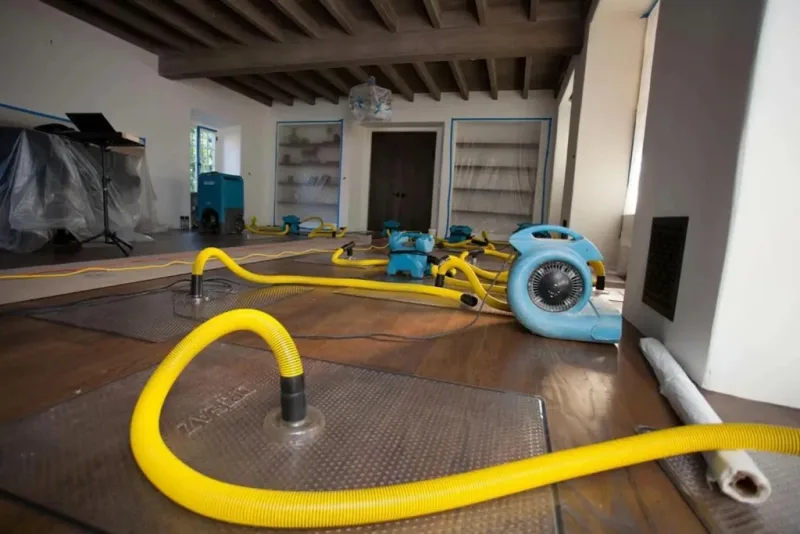
To pull water out from beneath the floor without removing the wood, we tape heavy-duty, gasketed vacuum drying mats directly over the wet floorboards, sealing them airtight with specialized non-marring tape. These mats are manifolded to an industrial high-pressure negative vacuum blower pulling up to 5 to 7 inches of mercury (Hg). The immense vacuum creates a low-pressure differential across the wood assembly, forcing trapped subfloor moisture and liquid water upward through the tongue-and-groove seams and micro-fissures into moisture separators, reversing cupping at the molecular level.
Hardwood drying requires ultra-low specific humidity that standard residential dehumidifiers cannot achieve. We stage industrial Low Grain Refrigerant (LGR) dehumidifiers or mobile desiccant dehumidifiers capable of driving ambient Grains Per Pound (GPP) below 30. We introduce heated, desiccated air directly into containment micro-environments established over the vacuum mat zones. Centrifugal air movers are positioned to create controlled laminar airflow across the mat perimeters without blowing hot air directly onto exposed bare wood, preventing surface checking and splintering.
In older Dallas architectural styles—such as historic craftsman bungalows in Lakewood or Tudor estates in East Dallas built over pier-and-beam foundations—drying from the top alone is insufficient. Moisture trapped in the crawlspace will continuously recharge the subfloor. Restore Crest simultaneously deploys commercial ground extraction and directional crawlspace drying blowers underneath the home, pulling moisture from both sides of the wood sandwich to eliminate mold spores before they can compromise our certified mold remediation standards.
Equipment is never removed based on guesswork or visual surface dryness. Our certified lead technicians conduct daily psychrometric and electronic moisture meter logging. We document that the floorboards and subfloor have returned within 2% to 4% of the baseline Equilibrium Moisture Content established during Phase 1. Once certified dry, we allow the wood assembly a 24-to-48-hour restabilization acclimation period to verify that cellular tension has normalized and cupping has fully receded prior to project sign-off.
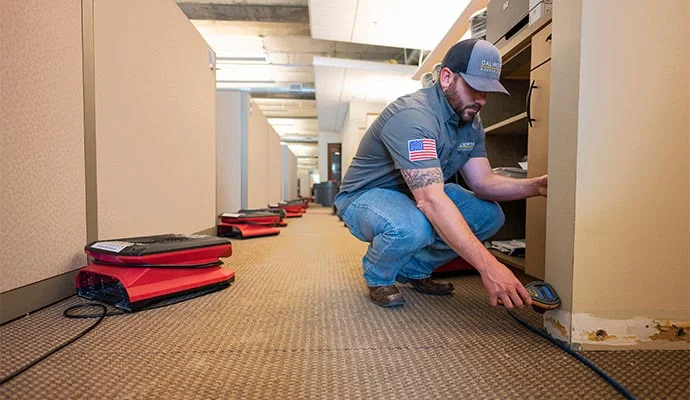
Authentic jobsite photography from real residential and commercial hardwood salvage deployments across North Texas.
The actions taken in the first two hours determine whether your hardwood floors can be saved in place.
We eliminate guesswork through calibrated digital telemetry, thermography, and core impedance sensors.
Detects evaporative thermal cooling boundaries invisible to the naked eye. Accurately maps the exact perimeter of moisture migration under baseboards and across large open living areas without lifting a single board.
Employs low-frequency electromagnetic signals to measure moisture content non-destructively through polyurethane sealants, factory aluminum oxide finishes, and wax coats without leaving pinholes or surface scratches.
Insulated steel pins penetrate through the hardwood planks into the underlying plywood or OSB subfloor. The insulation prevents false surface readings, providing true moisture gradients between the top, center core, and substrate.
Measures real-time ambient temperature, relative humidity (RH), dew point, and Grains Per Pound (GPP). Calculates vapor pressure differentials to ensure continuous moisture movement out of saturated hardwood cells.
Different wood species and manufacturing structures respond uniquely to water saturation. Our drying protocols adapt to each assembly.
Commonly installed in traditional and luxury Dallas estates across Highland Park, University Park, and Preston Hollow, solid hardwoods are single milled pieces of timber (typically 3/4-inch thick). Solid planks have the highest salvageability rate when treated early. Because the wood is homogeneous throughout, it tolerates substantial moisture loading without chemical breakdown.
Engineered hardwood features a real timber wear layer (lamella) bonded over cross-laminated plywood or high-density fiberboard (HDF). Widespread throughout modern North Dallas and Uptown developments, engineered flooring behaves differently when submerged. While cross-ply construction resists cupping better than solid wood, prolonged saturation causes adhesive hydrolysis, swelling of core layers, and permanent lamella delamination.
Custom herringbone, chevron, and intricate Versailles parquet installations feature wood grain running in multiple perpendicular directions within a tight geometric grid. When exposed to water, individual blocks expand against one another in conflicting vectors, risking catastrophic shattering of tongue joints and severe block detachment.
We never begin work without providing a complete, itemized, flat-rate estimate in writing. No hidden dispatch charges, no open-ended billing, and no surprise add-ons.
| Service Category | Technical Scope & Deliverables Included | Expected Duration | Transparent Flat Rate |
|---|---|---|---|
| Emergency Wood Moisture Diagnostic & Thermal Mapping | 45-minute on-site arrival, FLIR high-resolution thermal imaging, non-penetrating surface scans, hammer-probe subfloor readings, baseline Equilibrium Moisture Content calculation & written salvage assessment report | 1 - 2 Hours On-Site | $295 - $450 |
| High-Volume Squeegee Surface Water Extraction | Truck-mounted high-lift vacuum extraction using rubberized hardwood surface wands, moisture containment, and antimicrobial wash to prevent finish staining and mold growth | 2 - 4 Hours Initial Response | $0.75 - $1.35 / sq. ft. |
| Specialty Injectidry Negative-Pressure Vacuum Mat System | Commercial gasketed vacuum drying mats sealed over cupped boards, manifolded high-lift extraction pumps, liquid water separators, and non-marring floor protective films | 3 - 5 Days Active Operation | $495 - $795 / drying zone |
| Industrial Desiccant & LGR Structural Dehumidification | Commercial Low Grain Refrigerant (LGR) or desiccant dehumidifiers, high-velocity axial laminar air movers, micro-climate poly containment, and daily digital psychrometric logging | 3 - 5 Days Standard | $145 - $225 / day / unit |
| Subfloor Cavity & Crawlspace Simultaneous Drying | Under-floor positive pressure drying tubes for pier-and-beam foundations, crawlspace moisture extraction, and botanical antimicrobial sanitization to inhibit subterranean mold spores | 2 - 4 Days Active Operation | $395 - $695 / room |
We accept all standard direct payment methods including major credit cards, bank wire transfers, and corporate invoicing. You review and authorize all pricing line items upfront before technicians begin work.

"Water on hardwood is terrifying for a property owner because standard contractors immediately tell them the entire floor has to be ripped out. In more than 80% of residential floods where we arrive within 24 to 48 hours, our negative-pressure vacuum mats extract the trapped subfloor water, reverse the cupping, and preserve the original hardwood without demolition. I personally inspect every drying zone daily with hammer probes to guarantee the timber returns safely to its equilibrium moisture baseline."
Direct, authoritative technical answers on salvaging hardwood floors, drying timelines, cupping reversal, and upfront costs across Dallas, TX.
Yes. In the majority of Category 1 clean water losses where extraction begins within 24 to 48 hours, cupped hardwood floors can be 100% saved in place. Cupping occurs because the bottom face of the board is wetter than the top face. By sealing specialized Injectidry vacuum extraction mats over the wet planks, we draw trapped subfloor moisture directly upward through the tongue-and-groove joints. As the bottom dries and moisture equalizes with the top, the cellular tension relaxes and the boards flatten back down. Review our verified client outcomes on our reviews and testimonials page.
Under standard IICRC S500 psychrometric drying protocols, hardwood drying typically requires between 3 and 7 days of continuous operation. Hardwood releases bound water much more slowly than drywall or carpet because of its dense cellular structure. Our technicians monitor daily progress using deep insulated hammer probes and thermal imaging cameras to ensure wood fibers release moisture safely without drying so rapidly that surface checking occurs. Learn more about our complete capabilities in our Dallas disaster restoration services guide.
Sanding cupped wood while wet is one of the most destructive mistakes a property owner can make. When a board is cupped, its perimeter edges are raised because the bottom of the wood is swollen with water. If you sand off those raised edges, you are permanently removing wood material from the perimeter of the plank. Once the subfloor beneath finally dries out weeks later and the bottom shrinks back to normal size, the edges will drop lower than the center, leaving your floors permanently crowned with convex humps that cannot be fixed without complete floor replacement.
Engineered hardwood can be salvaged with vacuum mats, but the window of opportunity is much narrower—typically within the first 24 to 36 hours. Engineered wood consists of a real timber veneer bonded to multiple layers of plywood or high-density fiberboard (HDF). While the cross-grain core resists cupping, prolonged saturation causes the adhesive bond between layers to break down (hydrolysis), leading to permanent veneer delamination. If our crews arrive before delamination occurs, we can successfully dry the subfloor and save the floor. If water seeped into adjacent walls during the flood, our IICRC-certified Dallas restoration specialists simultaneously deploy wall cavity drying.
We never guess based on surface appearance or touch. We establish a verified dry baseline standard upon arrival by measuring unaffected hardwood in dry areas of your home. This Equilibrium Moisture Content (EMC) is typically between 7% and 9% in North Texas. Drying equipment runs until Delmhorst slide-hammer probe electrodes verify that the core of the floorboards and the underlying subfloor are within 2% to 4% of that dry standard. By returning the wood below 16% moisture content, fungal spores cannot germinate, permanently protecting your home against hidden mold colonization.
If the water source is Category 2 grey water (such as an overflowing washing machine or dishwasher) or Category 3 black water (such as a sewer backup or toilet overflow), the drying protocol changes. Porous materials like hardwood absorb biological contaminants that can harbor harmful pathogens. In grey water situations, we apply an EPA-registered botanical antimicrobial wash during extraction. However, in gross Category 3 sewage floods, health safety regulations may necessitate controlled removal under our certified commercial extraction protocols.
No. Our Injectidry vacuum mats are manufactured from flexible, industrial-grade composite materials edged with soft closed-cell foam gaskets. We secure the mats using specialized non-marring tape engineered specifically for delicate hardwood finishes. It leaves zero adhesive residue and will not pull up polyurethane or factory aluminum oxide coatings upon removal.
Yes, 100%. We operate with complete financial transparency. When our lead supervisor assesses your floor, you receive an itemized, flat-rate estimate covering all diagnostics, extraction, vacuum mat deployment, and dehumidification. You approve the exact scope of work in writing before any machinery is activated. No surprise fees, no hidden dispatch costs, and no open-ended hourly surprises.
Our emergency hardwood drying vehicles are staged across major North Texas highways for rapid deployment.
Do not let contractors tear out your original oak, walnut, or engineered hardwood before consulting our certified wood drying specialists. Every hour counts toward reversing cupping and avoiding permanent floor replacement. Speak directly with our on-duty field supervisor right now. We arrive in under 45 minutes with industrial vacuum injection mat rigs across Dallas County.
Fill out the details below. Our on-duty wood drying supervisor will contact you immediately.