North Texas native black gumbo clay soil traps subterranean moisture beneath Dallas pier-and-beam homes, releasing thousands of gallons of water vapor directly against wooden floor joists, primary girders, and subfloor assemblies. Through the thermal stack effect, up to half of that humid, spore-laden subterranean air migrates straight into your living rooms and bedrooms. Restore Crest designs and installs engineered 20-mil multi-layer reinforced vapor encapsulation systems, commercial subterranean dehumidification units, and automatic sump drainage infrastructure across Old East Dallas, Lakewood, Hollywood/Santa Monica, Oak Cliff, and Munger Place to permanently eliminate wood rot, stop foundational settling, and slash summer cooling loads.

Speak directly with an on-duty field supervisor. Immediate dispatch across North Texas in under 45 minutes.
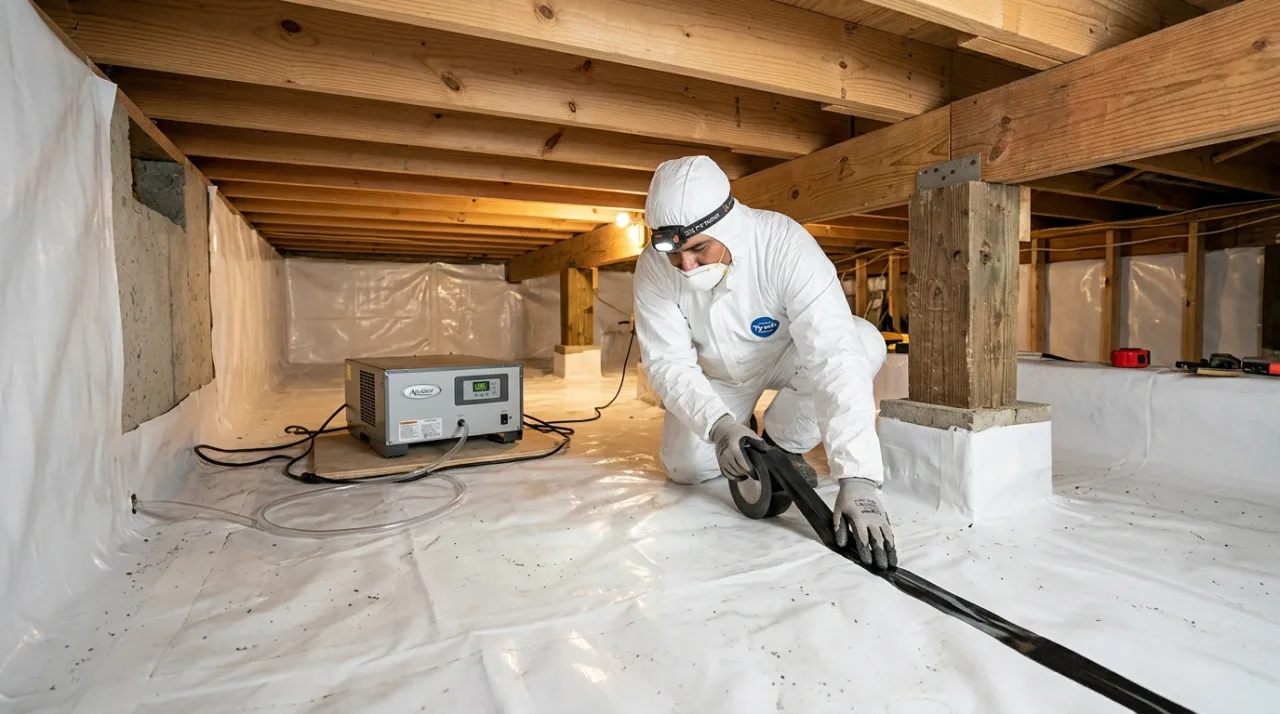
Understanding expansive Houston Black clay soil, subterranean vapor drive, architectural stack dynamics, and timber saturation across Dallas County pier-and-beam properties.
Dallas vertisol gumbo clays shrink 6 feet deep in drought, then swell up to 30% during convective storms. Hydrostatic pressure traps subterranean water directly beneath pier-and-beam foundations across Lakewood and Munger Place.
95°F outdoor summer air at 80% RH enters open vents and hits 68°F air-conditioned floor ducts, condensing directly onto wooden girders. Traditional vents act as giant moisture pumps that soak structural joists daily.
Buoyancy forces warm indoor air upward, creating negative ground pressure that pulls 40% to 50% of your indoor breathing air straight from the crawl space. Sucks mold spores, damp air, and MVOCs into bedrooms and kitchens.
Our technicians install 20-mil multi-layer reinforced liners, cast-iron sump pumps, and commercial low-clearance dehumidifiers. Prior water is evacuated via our crawl space water extraction team.
How sustained relative humidity above 70% destroys Southern yellow pine floor joists, buckles expensive hardwood flooring, and compromises foundation load ratings.
Healthy Southern yellow pine framing sits at 8%–12% EMC. Unsealed Dallas crawl spaces drive moisture past 28%, filling cellular lumens with free water and triggering rapid wood softening.
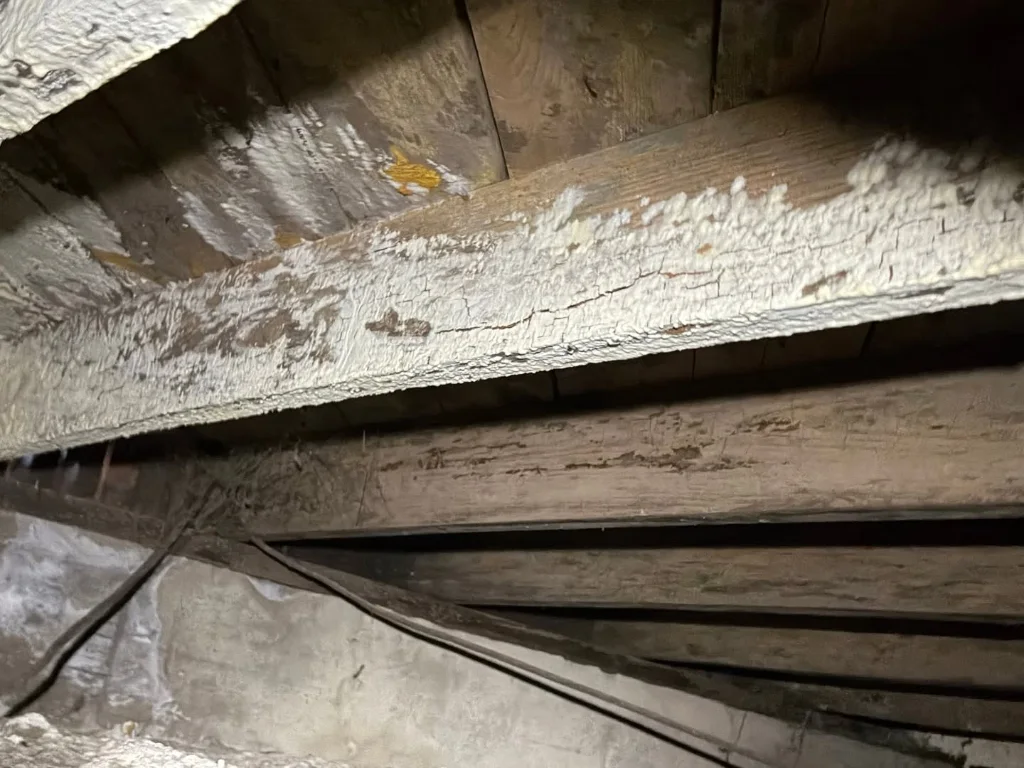
Wood-destroying fungi digest structural cellulose and hemicellulose. Floors become spongy and bounce. Sanitized and abraded by our mold remediation team before encapsulation.
Vapor pushes upward into original red oak and longleaf pine hardwoods. Planks cup and warp. Rescued in-place by our hardwood injection drying mats.
Termites and powderpost beetles require over 15% wood moisture. Regulating humidity below 55% RH starves biological vectors, protects structural integrity, and secures foundations.
From subterranean debris clearance and laser grading to 20-mil multi-layer seam welding and dedicated commercial dehumidification, we deliver complete sub-structural stabilization.
Our technicians enter the sub-structure in full PPE to remove organic contaminants that could puncture the barrier or harbor microbial rot. We extract fallen fiberglass insulation batts, scrap construction lumber, sharp rocks, discarded masonry rubble, and organic root growth. The crawl space floor is then regraded with laser leveling tools, creating smooth directional contours sloping toward perimeter drainage channels or planned sump collection locations to prevent future pooling beneath the membrane.
Encapsulation must not trap bulk liquid under the membrane. If your property experiences hydrostatic groundwater intrusion or perimeter seepage, we trench a perforated perimeter French drain system bedded in washed river gravel. This directs groundwater into a heavy-duty, airtight polyethylene sump basin equipped with a commercial 1/2 HP cast-iron submersible sump pump, dual float switches, check valves, and sealed perimeter lid gaskets that evacuate intruding water away from the foundation.
Prior to sealing the crawl space, all exposed wooden framing members—including primary floor joists, rim joists, subfloor decking, and sill plates—undergo detailed surface cleansing and antimicrobial decontamination. We apply an EPA-registered hospital-grade biostatic wash using commercial airless sprayers. This biocide penetrates timber pores, neutralizing existing mold spores and wood-decay mycelium while applying a residual zinc or borate-based barrier that inhibits future fungal growth.
We roll out commercial 20-mil virgin polyethylene sheeting reinforced with multi-directional polyester scrim over the entire earthen floor. Unlike thin, unreinforced 6-mil poly that punctures and tears, our 20-mil membrane withstands heavy crawling, service personnel traffic, and sharp substrate pressure. Sheets are overlapped by a minimum of 12 inches, permanently welded with waterproof butyl mastic tape, and mechanically secured around every structural pier, plumbing stack, and support column.
The 20-mil vapor barrier is extended up the vertical concrete or brick foundation stem walls, terminating with mechanical termination bars and heavy polyurethane adhesive just below the sill plate to maintain a visible 3-inch termite inspection gap. All exterior foundation vents are permanently sealed with insulated, waterproof composite covers. Rim joists and sill plate intersections receive closed-cell polyurethane spray foam insulation to prevent outdoor air infiltration and stop thermal bridging.
To maintain strict psychrometric stability, we suspend a dedicated, commercial-grade low-clearance crawl space dehumidifier (such as a Santa Fe or AprilAire system) using vibration-isolating hangar brackets. The unit is hard-piped with PVC condensate drain lines routed directly to the sump basin or exterior discharge. We calibrate the onboard digital humidistat to hold crawl space relative humidity strictly below 55% RH, pairing it with a wireless remote hygrometer sensor that alerts you directly on your smartphone.
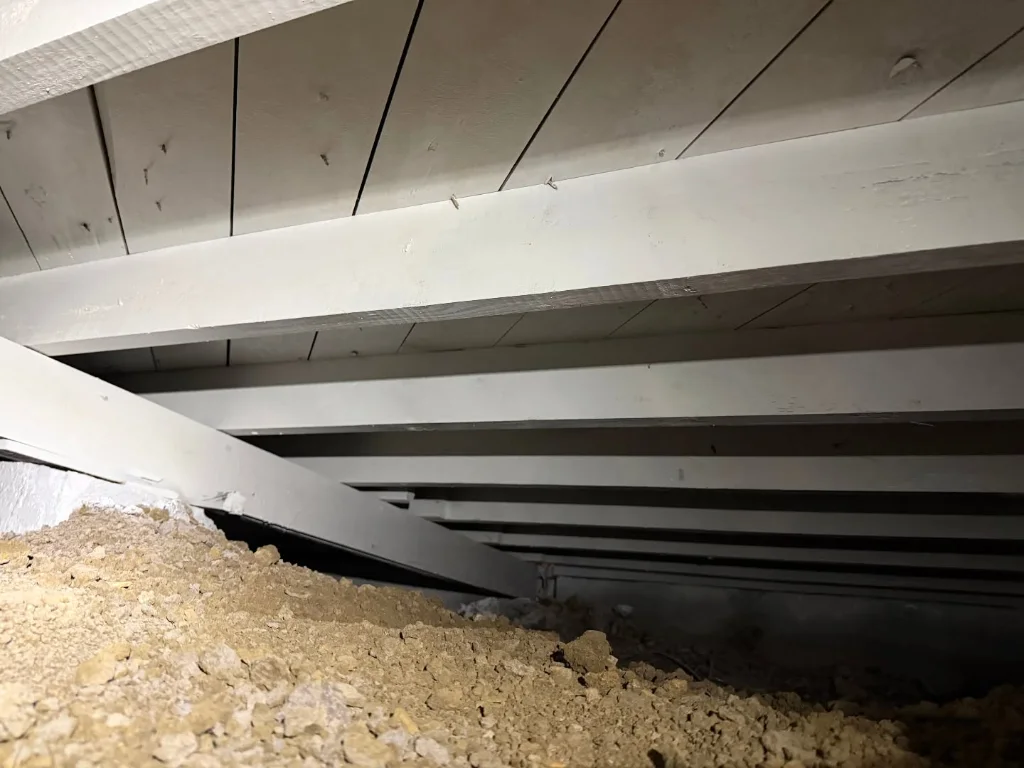
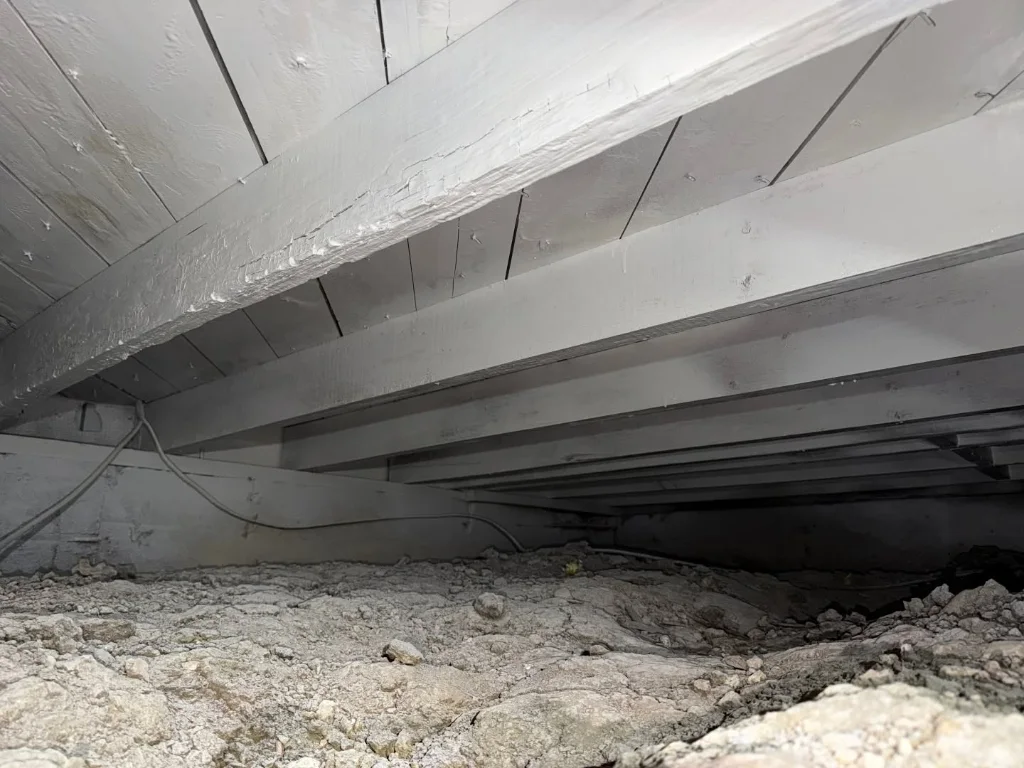
On-site photographic records of engineered 20-mil vapor barrier installs, joist drying, and commercial dehumidification across Dallas County.
How sealing your crawl space reduces summer cooling energy consumption by up to 25% while permanently eliminating subterranean allergens, musty odors, and soil gas migration.
Most North Texas homeowners consider crawl space encapsulation strictly as a moisture defense and foundation protection strategy. However, the thermodynamic impact on household energy consumption and respiratory wellness is equally transformative. In conventional pier-and-beam homes with open foundation vents, air conditioning ductwork is suspended directly within the hot, humid subterranean cavity. Even with modern R-6 or R-8 duct insulation, convective thermal transfer warms the conditioned air traveling through the ducts before it reaches your living room registers. More critically, high ambient humidity in the crawl space causes external condensation to sweat along metal duct jackets, rotting fiberglass insulation and leaking water into subfloor framing.
By bringing the crawl space into the conditioned thermal envelope of the building, the ambient temperature surrounding your ductwork drops by 15 to 25 degrees Fahrenheit during extreme Dallas summer heatwaves, while relative humidity falls from 85% to a steady 50%. Your central HVAC system no longer has to contend with massive latent heat loads—the thermal energy required to wring airborne moisture out of the air before sensible cooling can occur. Mechanical engineering field studies demonstrate that encapsulating a vented crawl space reduces whole-home air conditioning operational demands by 15% to 25%, extending compressor lifespan, preventing frozen evaporator coils, and yielding significant reductions in monthly electric utility bills across our extreme North Texas cooling season.
From an indoor air quality perspective, crawl space encapsulation represents the single most impactful structural upgrade a pier-and-beam homeowner can undertake. Because the architectural stack effect continuously draws up to half of your ground-floor breathing air from beneath your floors, an unsealed crawl space directly contaminates your living environment. Saturated soil continuously releases earth odors, microbial volatile organic compounds (MVOCs) produced by fungal metabolism, damp soil actinomycetes bacteria, and dormant allergen particulates. Family members suffering from asthma, chronic allergies, or upper respiratory irritation frequently experience immediate symptom relief once the subterranean thermal vacuum is sealed with a non-permeable 20-mil membrane.
Furthermore, encapsulation prevents subterranean soil gases—including hazardous radon, methane from decomposed organic matter, and volatile pesticides applied around older Dallas foundations—from diffusing upward through flooring gaps. When paired with high-efficiency MERV 11 filtration on our dedicated commercial dehumidification units, the encapsulated crawl space becomes an immaculately clean, conditioned buffer zone that safeguards structural lumber, protects finished flooring, and guarantees pristine, healthy breathing air throughout your entire home. For comprehensive whole-home disaster protection, our crews frequently coordinate sub-structure moisture mitigation with our full-spectrum water damage restoration solutions across the Dallas area.
Practical guidance for Dallas homeowners managing pier-and-beam crawl spaces. Protect your family, avoid costly mistakes, and preserve structural stability.
Tailoring sub-structure vapor defense to the architectural demands of historic Dallas homes and expansive commercial, medical, and institutional facilities.
Neighborhoods such as Munger Place, Old East Dallas, Lakewood, and Winnetka Heights feature historic craftsman bungalows, prairie-style estates, and tudor cottages built in the 1910s to 1940s. These homes rest on shallow brick or cedar pier footings directly atop Dallas black gumbo clay. Uncontrolled moisture cycles cause individual piers to heave or settle unevenly, wrenching delicate interior plaster, binding historic solid wood doors, and threatening original architectural features.
Our residential encapsulation preserves historic framing integrity by stabilizing subterranean moisture levels year-round. By maintaining constant equilibrium moisture content in the underlying clay and timber framing, we halt differential foundation settling and preserve historic integrity. When subterranean plumbing lines rupture in older crawl spaces, our rapid response units mobilize in under 45 minutes to execute emergency burst pipe cleanup and water extraction before installing permanent vapor barriers.
Light commercial office buildings, private schools, veterinary hospitals, religious sanctuaries, and medical clinics in Dallas often utilize extensive elevated sub-structures to house high-voltage electrical conduit, data backbones, hydronic lines, and complex commercial mechanical systems. A damp, unconditioned commercial crawl space leads to corroded electrical boxes, short circuits, degraded low-voltage wiring, and pervasive musty odors that compromise indoor air standards.
Our commercial water damage recovery specialists deploy multi-crew industrial encapsulation setups, utilizing multi-layer high-tensile membranes, commercial negative air containment machines, and high-capacity desiccant dehumidifiers. We work around facility schedules, ensuring sensitive clinical operations and corporate offices above experience zero downtime and zero contamination during installation.
Restore Crest operates with complete pricing honesty. You receive an itemized, transparent flat-rate written quote before any work begins. Zero hidden line items, zero travel surcharges, and zero surprise billing.
| Service Line Item | Technical Scope Included | Typical Duration | Transparent Flat Rate |
|---|---|---|---|
| Comprehensive Crawl Space Diagnostic & Moisture Audit | FLIR thermal imaging, digital WMC wood moisture mapping, relative humidity logging, elevation laser grading audit | 1.5 - 2 Hours | $295 - $450 |
| Debris Clearing, Insulation Extraction & Laser Grading | Fallen fiberglass batt haul-away, organic wood scrap removal, earth raking & smooth laser slope grading | 1 - 2 Days | $0.95 - $1.75 / sq. ft. |
| EPA Hospital-Grade Biocide Joist Scrub & Spore Wash | Broad-spectrum botanical antimicrobial fogging and joist scrubbing, negative air HEPA filtration | 1 Day | $450 - $850 / zone |
| ASTM E1745 Class A 20-Mil Reinforced Liner Installation | Multi-layer 20-mil virgin poly, 12-inch overlap seams welded with butyl mastic, pier wrapping & wall anchoring | 1 - 2 Days | $2.45 - $3.95 / sq. ft. |
| Foundation Stem Wall, Vent & Rim Joist Air Sealing | Closed-cell spray foam insulation on rim joists, waterproof composite vent covers, mechanical termination bars | 1 Day | $650 - $1,250 |
| Internal French Drainage & Smart Sump Basin System | Perimeter trenching, perforated gravel drain tile, airtight sealed basin, 1/2 HP cast iron pump, dual check valves | 1 - 2 Days | $1,850 - $3,200 |
| Commercial Sub-Structure Dehumidifier & Wireless Monitor | Low-clearance Energy Star unit (70-110 pints/day), anti-vibration hangers, PVC hard-piped drain, mobile hygrometer | 4 - 6 Hours | $1,650 - $2,450 |
Complete subterranean debris clearance, ground laser smoothing, and heavy 20-mil multi-layer reinforced vapor barrier installation with fully taped 12-inch overlap seams. Ideal for dry crawl spaces needing ground evaporation containment.
Includes full Tier 1 scope plus vertical foundation stem wall wrapping, foundation vent insulation seals, rim joist spray foam air sealing, and an EPA-registered biostatic antimicrobial wash on all exposed structural floor joists.
The ultimate whole-structure protection package: full perimeter encapsulation, internal French drainage trenching, smart cast-iron sump pump system, and a commercial low-clearance dehumidifier with wireless remote smartphone monitoring.
Backed by our 100% Upfront Transparent Direct Pricing Guarantee. Every line item is approved by you in writing before any installation begins. Direct residential and commercial payment accepted. For additional property services, consult our complete Dallas restoration service catalog.
"Dallas pier-and-beam homes face extreme moisture conditions due to our native black gumbo clay. Vented crawl spaces in North Texas invite 90-degree humid air that condenses directly on chilled subfloor framing, rotting joists from below. My team installs true commercial-grade 20-mil multi-layer reinforced barriers, seals foundation stem walls, and commissions dedicated subterranean dehumidifiers. We do not cut corners with thin plastic. We deliver engineered building envelopes that keep your subfloors bone dry for decades."
Accurate answers on 20-mil vapor barriers, black gumbo clay soil dynamics, joist dry rot prevention, energy savings, and upfront pricing.
A standard vapor barrier is typically a thin 6-mil plastic sheet loosely laid over the dirt floor without taped seams, wall anchoring, or perimeter vent sealing. Crawl space encapsulation is an engineered building-envelope system. We grade the earth, install an ASTM E1745 Class A heavy 20-mil reinforced membrane with 12-inch taped overlaps, extend the barrier up foundation stem walls, hermetically seal all foundation vents and rim joists, and install a dedicated commercial dehumidifier to maintain relative humidity below 55% RH year-round.
Dallas summers bring outdoor air temperatures in the 90s with relative humidity levels exceeding 75%. When this humid exterior air enters cooler, shaded crawl spaces (typically 68 to 72 degrees Fahrenheit due to indoor air conditioning), the air cools below its dew point. Condensation forms on wooden floor joists, primary beams, and cold metal ductwork. Vents act as moisture injectors rather than ventilators, driving wood moisture content above 25% and causing severe structural rot and mold proliferation.
Warm air rises inside your home and escapes through attic vents and recessed lighting fixtures, creating negative atmospheric pressure on the lower levels. This natural thermal vacuum pulls up to 50% of your indoor breathing air straight from the sub-structural crawl space. If that subterranean space contains raw damp soil, fungal spores, or rotting timbers, hazardous mycotoxins, odors, and allergens are drawn directly into your bedrooms and living quarters. Encapsulation permanently seals this pathway.
Standard 6-mil poly is unreinforced and easily punctures on small stones, tears when plumbers or HVAC technicians crawl over it, and degrades within a couple of years. Our 20-mil multi-layer virgin polyethylene membrane is reinforced with high-tensile polyester scrim, meeting ASTM E1745 Class A puncture and tensile standards. It provides an impermeable vapor perm rating of 0.008, withstands heavy maintenance foot traffic, and lasts for decades without deterioration.
Yes. Sealing the foundation vents and installing a heavy barrier stops ground evaporation and exterior air infiltration, but residual moisture from masonry stem walls, plumbing humidity, and structural framing requires mechanical regulation. A dedicated low-clearance commercial dehumidifier (such as a Santa Fe or AprilAire system) automatically cycles on to hold relative humidity strictly below 55% RH, completely preventing the microclimates that foster wood-decay fungi and insect infestation.
Encapsulation stops the root cause of wood rot and subfloor sagging by permanently removing excess moisture and lowering timber moisture content back to safe equilibrium (below 12%). If structural joists or primary girders have already sustained severe biological degradation, we partner with specialized foundation carpenters to sister damaged joists or install supplemental steel screw jacks before completing final encapsulation sealing.
We never encapsulate over standing water or unresolved plumbing breaches. If water is present, our emergency mitigation division deploys commercial submersible trash pumps to evacuate all standing mud and liquid via our crawl space water extraction protocol. Once bulk water is removed and plumbing lines are repaired, we dry the framing to IICRC standards before installing the 20-mil vapor barrier and internal sump basin infrastructure.
Field studies conducted by advanced energy research organizations show that sealing and conditioning a crawl space reduces summer cooling electricity consumption by 15% to 25%. By eliminating high subterranean humidity and dropping the temperature surrounding under-floor air conditioning ducts, your HVAC equipment runs far more efficiently, eliminates duct sweat, and cools your living spaces with significantly lower runtime.
Many renovated historic Dallas homes feature slab additions adjacent to the original pier-and-beam footprint. Uncontrolled moisture in the crawl space causes clay swelling that heaves against the edge of the adjacent slab foundation, cracking concrete and stressing buried plumbing lines. If foundation soil movement has compromised slab plumbing, our technicians cross-reference diagnostics with our specialized Dallas slab leak detection team to preserve both foundation structures.
Contact Restore Crest directly at +1 (214) 491-5611 or fill out our online consultation form below. Our on-duty field supervisor will arrive at your property, enter the crawl space, measure the square footage, evaluate soil drainage, test timber moisture content, and deliver a comprehensive itemized flat-rate proposal in writing. Learn more about our company standards on our about us page or schedule your assessment today through our 24/7 contact portal.
Restore Crest operates dedicated sub-structure mobile response units dispatched along primary Dallas transit arteries for guaranteed rapid consultation arrival.
Every humid North Texas season an unsealed crawl space remains exposed to native black gumbo clay evaporation, structural floor joists weaken, hardwood floors cup, and airborne spores migrate into your bedrooms. Speak directly with David Vance or our on-duty sub-structure operations team now to schedule your comprehensive on-site diagnostic audit.
Complete the form below. Our on-duty field supervisor will contact you immediately.