Commercial elevator pit flooding compromises structural hoistway integrity, shorts traveling cables, corrodes buffer springs, and contaminates sump pits with emulsified hydraulic fluid. Restore Crest delivers rapid OSHA-certified confined-space pumping, hydrocarbon sheen separation, and deep desiccant drying across Downtown Dallas, Uptown, the Medical District, and the Stemmons Corridor in under 45 minutes. We collaborate seamlessly with licensed elevator technicians to safely pump, sanitize, and desiccate flooded elevator shafts to TDLR and ASME A17.1 clearance standards.

Speak directly with an on-duty field supervisor. Immediate dispatch across North Texas in under 45 minutes.
Understanding North Texas clay soil expansion, hydrostatic groundwater intrusion, hydraulic oil emulsification, and critical life safety systems in commercial vertical transportation shafts.
Dallas black gumbo clay expands 30% during storms, exerting massive upward pressure against subterranean pit walls. Groundwater surges through cold joints, requiring our commercial large-loss extraction fleet to prevent foundation cracking like an active slab leak.
Hydraulic elevator pits house cylinder return lines. Groundwater mixes with petroleum jack oil, creating a hazardous slurry. Under EPA statutes, direct discharge is illegal. We deploy coalescing separators compliant with our biohazard cleanup protocols.
In traction elevators, standing water wicks up porous multi-conductor cables, shorting 480V drives and microprocessor safety switches. If cars descend into water at 1,000 FPM, hydraulic waves rip doors off tracks and cause governor lockouts.
Across our entire DFW service area, our IICRC certified master restorers follow ASME A17.1 standards with high-flow submersible pumping and deep desiccant drying under our restoration catalog.
From mechanical sump pump burnouts to subterranean hydrostatic surges and high-rise plumbing pipe ruptures, pinpointing the intrusion pathway is essential for lasting remediation.
Commercial elevator pits are engineered with a recessed collection sump basin and an electric sump pump designed to discharge minor condensation and packing seepage. During heavy North Texas storm cycles, these pumps run continuously. Inadequate maintenance, float switches tethered or hung up against pit walls, impeller calcification, or motor coil burnout causes the pump to cease functioning. Water rapidly fills the collection basin, overflows onto the pit floor, and rises several feet up the hoistway walls.
Because elevator pits sit four to ten feet deeper than the surrounding basement or parking foundation, they intercept the subterranean water table first. When intense rain saturates Dallas clay, water pressure mounts under the pit floor slab. Water seeks the path of least physical resistance, violently penetrating the cold joint between the horizontal pit floor and vertical concrete shaft walls, pushing through honeycomb concrete pockets and unsealed pipe sleeves in fountain-like geysers.
Elevator hoistways act as vertical conduits connecting every floor of a multi-story building. When a commercial domestic water booster riser, closed-loop HVAC chilled water pipe, or pressurized fire sprinkler head bursts on an upper floor, thousands of gallons of pressurized water seek gravity relief. Water pours into elevator door sills on upper landings, cascading down the entire vertical shaft like a torrential waterfall and collecting at the bottom of the pit, requiring coordinated emergency pipe burst water extraction protocols.
During intense Dallas rain events along major transit corridors like the Woodall Rodgers Freeway, Central Expressway (US-75), and I-35E, municipal storm sewers become pressurized and overflow. If the commercial building's pit drainage line connects to a gravity storm or sanitary line without a functioning backwater check valve, the municipal system pushes contaminated stormwater and raw sewage backwards into the pit, demanding our emergency sewage backup decontamination procedures.
High-rise buildings in Uptown Dallas, Turtle Creek, and Downtown feature multi-tier subterranean parking structures. Torrential flash floods cascade down access ramps when street-level storm grates are overwhelmed. As parking decks submerge, floodwaters overflow garage trench drains, bypass elevator vestibule thresholds, and pour directly into passenger and freight elevator hoistways, similar to a sudden subterranean basement flood emergency.
In in-ground hydraulic elevators, the hydraulic cylinder extends deep into an underground casing well bored beneath the pit floor. Over time, electrolytic soil corrosion can perforate the steel cylinder casing, allowing groundwater to flood upward into the pit around the jack assembly. Concurrently, failed scavenger return pumps allow recirculating hydraulic fluid to overflow the collection reservoir, mixing directly with incoming groundwater to create an oily hazardous mess.
Different elevator propulsion systems present vastly different mechanical vulnerabilities, hazard classifications, and restoration methodologies when submerged.
Hydraulic elevators rely on a fluid-driven piston to lift the elevator car. The pit contains the hydraulic cylinder assembly, packing gland seals, hydraulic fluid supply lines, scavenge pump reservoirs, car spring buffers, and pit emergency stop switches.
Traction elevators utilize steel hoist ropes routed over a drive sheave with a heavy counterweight. Traction pits are significantly deeper and house massive car and counterweight oil buffers, governor rope tension sheaves, compensating cable guide assemblies, and traveling cable loops.
An elevator pit is classified under federal law as a permit-required confined space. Entering an unventilated, flooded elevator shaft without certified safety gear risks fatal asphyxiation, electrocution, or mechanical crush injuries.
Commercial property managers and facility directors must understand that an elevator pit is legally defined by OSHA as a Permit-Required Confined Space (PRCS). Pits have limited means of entry and egress (typically a single vertical wall ladder), are not designed for continuous human occupancy, and present severe physical and atmospheric hazards. When floodwater enters a pit, decomposing organic silt, stagnant drainage, and vaporizing hydraulic oil generate deadly gases while displacing breathable oxygen. Untrained building personnel must NEVER enter a flooded elevator pit.
Anaerobic bacterial decay in stagnant water produces toxic Hydrogen Sulfide (H2S) and Methane (CH4). Decomposing organic matter and rusting steel buffers consume oxygen, driving O2 levels below the safe 19.5% threshold. Vaporized hydraulic oil adds volatile organic compounds (VOCs), creating explosive atmospheres that can be ignited by an electrical spark.
Elevator cars and multi-ton counterweights move overhead at high velocity. Without formal Lockout/Tagout (LOTO) protocols and mechanical pit prop blocks, an inadvertent call from an upper landing or hydraulic valve slip can cause a descending car or counterweight to crush an entrant against the pit floor.
Elevator hoistways carry 480-volt, three-phase main power alongside 120-volt safety interlock loops, pit lighting circuits, and traveling cable feeds. Standing water creates conductive pathways between exposed junction terminals, submerged stop switches, and metal pit ladders, presenting lethal shock and arc-flash dangers.
When water is discovered entering an elevator pit or shaft in a commercial building, follow these critical steps before our industrial pumping rigs arrive on site.
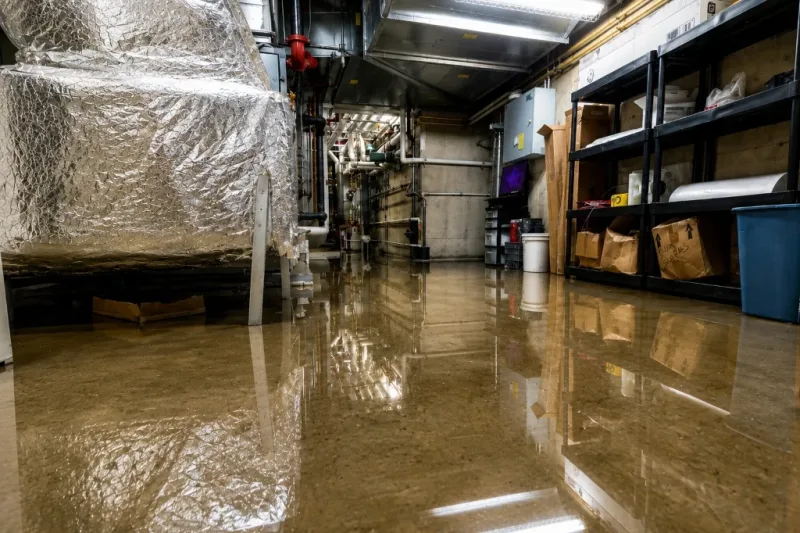
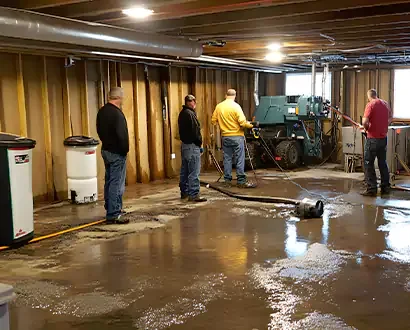
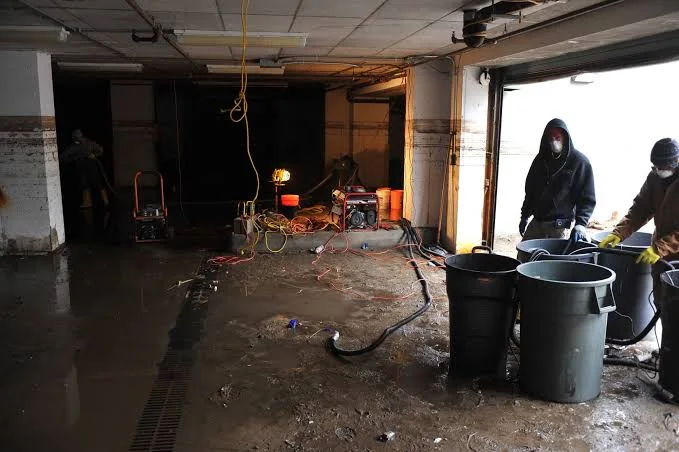
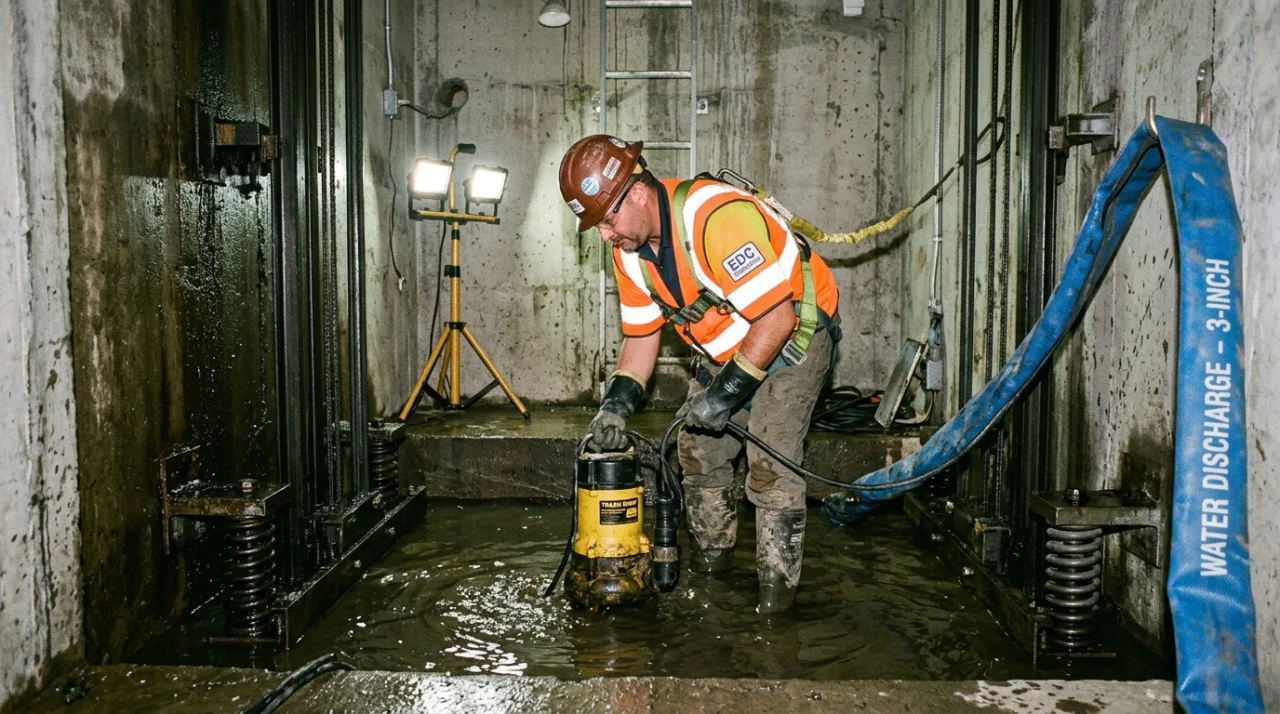
Authentic on-site documentation of commercial elevator pit extraction, oil-water containment, and subterranean hoistway desiccation across the Dallas-Fort Worth metroplex.
Every flooded elevator pit recovery follows a rigorous engineering process adhering strictly to OSHA 29 CFR 1910.146, ASME A17.1 elevator safety codes, and IICRC S500 water restoration standards.
Before any equipment is connected or access doors are opened, our field supervisor coordinates with the building engineer and licensed elevator service provider. We verify that main three-phase 480V disconnect switches in the machine room are locked out, tagged out, and verified de-energized. Elevator cars are confirmed mechanically parked on upper floors, pit stop switches are engaged, and mechanical pit props are positioned to eliminate any risk of accidental car descent.
Our certified Confined Space Entry Supervisor uses a calibrated four-gas electronic detector to sample the pit atmosphere at top, middle, and floor elevations. We record Oxygen (O2), Carbon Monoxide (CO), Hydrogen Sulfide (H2S), and Lower Explosive Limit (LEL) levels. Intrinsically safe, explosion-proof positive-pressure axial blowers with antistatic ducting are deployed to purge hazardous vapors and establish continuous breathable airflow throughout the extraction operation.
We deploy high-head, continuous-duty stainless steel electric submersible pumps or explosion-proof pneumatic air-diaphragm pumps capable of lifting floodwaters up 30 to 50 vertical feet out of deep subterranean shafts. Standing water is evacuated at rates up to 8,000 gallons per hour through heavy-duty discharge lines. In shallow or sensitive pit geometries, truck-mounted high-vacuum extraction tools pull water down to within a fraction of an inch from the concrete slab.
If hydraulic fluid, rail grease, or oil sheen is present on the water surface, our technicians deploy oleophilic hydrophobic containment booms and mechanical surface skimmers. Fluid is routed through mobile coalescing oil-water separation tanks on site. Recovered hydraulic oils and petroleum hydrocarbons are captured in hazardous waste recovery drums for legal recycling, ensuring zero contaminated discharge into City of Dallas municipal sewer systems.
Flooding leaves behind a thick coating of conductive riverbed silt, organic clay mud, and grease deposits across the pit floor, buffer springs, and sump basin. Our certified entrants physically shovel, vacuum, and wipe down pit assemblies. We apply EPA-registered broad-spectrum botanical antimicrobials that neutralize bacterial pathogens, inhibit mold spores, and eliminate odors without causing corrosive damage to sensitive copper wiring or steel guide rails.
Concrete pit walls and structural floor slabs retain thousands of pounds of absorbed moisture that will continuously evaporate into the hoistway, causing rust on guide rails and traveling cables. We duct super-dry, low-grain air from industrial desiccant dehumidifiers directly to the pit floor. High-velocity air movers evaporate moisture out of electrical junction boxes, buffer casings, and traveling cable bundles until digital moisture verification confirms certified dry equilibrium standards.
Different commercial building designs present distinct vertical transportation configurations, passenger demands, and compliance obligations. Restore Crest tailors extraction protocols across four key sectors.
Prominent commercial high-rises along Pacific Avenue, Elm Street, Main Street, and Ross Avenue feature multi-car elevator banks with deep pits extending two stories below street level. A flash flood in an underground parking garage or a ruptured chilled water riser can flood an entire four-car elevator bank, crippling tenant mobility and halting business operations across forty floors.
Restore Crest mobilizes multi-rig pumping packages that simultaneously evacuate water from adjacent pits, isolate common hoistway dividers, and deploy high-volume desiccant trailers. We work directly with facility directors to stage after-hours drying, expediting state elevator re-inspection and minimizing tenant disruption.
Healthcare campuses including Parkland Memorial Hospital, UT Southwestern Medical Center, Children's Medical Center, and Baylor University Medical Center rely on high-capacity hospital bed elevators and trauma service elevators. Out-of-service elevators directly endanger patient transport and emergency clinical response times.
Our healthcare response teams maintain strict Infection Control Risk Assessment (ICRA) compliance. We deploy HEPA-filtered negative-air scrubbers, establish sealed dust containment barriers at hospital elevator landings, and utilize hospital-grade EPA botanical biocides to prevent airborne fungal contamination from spreading into patient care wards.
Multi-family apartment buildings and luxury condominium towers throughout Oak Lawn, Victory Park, the Design District, and West Village often operate with only one or two passenger elevators per residential tower. When subterranean stormwater overflows basement courtyards and floods the pit, residents face severe accessibility challenges and ADA non-compliance.
We deploy ultra-quiet electric extraction machinery and low-noise desiccant dehumidifiers that operate without disturbing residential tenants. Our rapid turn-around pumping clears pits within hours, allowing elevator technicians to replace blown safety switches and restore residential elevator service that same day.
Heavy industrial distribution centers, cold-storage warehouses, and manufacturing plants along the Stemmons Corridor, Elm Fork Industrial District, and near DFW International Airport utilize heavy freight elevators with massive pit footprints. Flooding here frequently involves thick industrial grime, pallet debris, and chemical runoff.
We deploy heavy solids-handling trash pumps and pneumatic extraction rigs that clear water containing wood splinters, cardboard pulp, and heavy silt. Technicians perform power-washing, degreasing, and concrete sanitization, coordinating closely with our commercial facility restoration teams.
Commercial facility managers and property owners deserve complete financial predictability. Restore Crest provides 100% transparent, line-item itemized pricing before work begins. No unexpected emergency surcharges, no hidden fees.
Water depth under 12 inches across a single hydraulic or traction pit. Zero heavy hydrocarbon oil emulsion. Includes OSHA confined-space air testing, submersible pumping, silt vacuuming, biocide wipe-down, and a 24-hour drying staging package.
Water depth 12 to 36 inches with hydraulic oil surface sheen or sediment buildup. Involves high-head pumping, hydrocarbon absorbent booming, surface oil skimming, sump basin mucking, and industrial desiccant airflow drying.
Severe flooding over 36 inches, multi-car elevator banks in high-rises, heavily emulsified hydraulic oil, or sewage surcharges. Multi-rig pumping, full hazardous waste recovery drumming, and deep traveling cable desiccation.
| Mitigation Line Item | Technical Scope of Work | Deployment Duration | Transparent Flat Rate |
|---|---|---|---|
| Emergency Confined-Space Triage & 4-Gas Air Testing | 45-min arrival, OSHA permit protocol, continuous electronic O2/CO/H2S/LEL testing, LOTO coordination | 1 - 2 Hours Active | $395 - $550 |
| High-Head Submersible Extraction (Up to 30' Vertical Lift) | Stainless steel continuous-duty submersible pumping, high-pressure discharge routing to municipal approved points | 2 - 4 Hours Active | $850 - $1,750 |
| Hydrocarbon Oil Skimming & Coalescing Separation | Oleophilic skimmers, oil-absorbent booms, on-site hydrocarbon phase separation & hazardous waste recovery drumming | Per Pit Shaft | $750 - $1,650 |
| Pit Sump Silt Scraping & Antimicrobial Wash | Manual mucking of clay sediment, buffer spring degreasing, hospital-grade EPA biocide concrete application | Full Pit Scope | $450 - $950 |
| Industrial Desiccant Hoistway Dehumidification | High-capacity low-grain desiccant unit ducted into pit floor, drawing deep moisture from porous concrete slabs | Daily Unit Rate | $185 - $295 / day |
| Traveling Cable & Safety Sensor Desiccation | Positive-pressure warm dry airflow injection drying cable bundles, limit switches, and pit stop interlocks | Per Elevator Car | $450 - $850 |
All pricing backed by our 100% Upfront Pricing Guarantee. Every scope item is presented in writing and approved before our mitigation crew powers on equipment. Read verified commercial client reviews on our reviews and testimonials page.
"Pumping a flooded elevator pit is one of the highest-stakes operations in commercial disaster recovery. You are dealing with 480-volt electrical services, hazardous hydraulic oil emulsions, and an OSHA permit-required confined space. If a contractor drops an uncertified pump into that pit, they risk igniting volatile fumes, electrocuting technicians, or illegally discharging hazardous hydrocarbons into the Dallas municipal storm sewer. We operate with strict Lockout/Tagout protocols, 4-gas atmospheric monitoring, and industrial oil-water separation. We provide upfront, line-item flat pricing so facility directors have total transparency from minute one."
Authoritative, engineering-grade answers to critical questions regarding elevator pit flooding, OSHA confined spaces, traveling cable preservation, oil separation, and upfront costs across Dallas, TX.
Our commercial rapid-response pumping units arrive on-site across Downtown Dallas, Uptown, the Medical District, and the Stemmons Corridor in under 45 minutes from your emergency call. We maintain fully equipped confined-space extraction trailers stationed along major DFW highway arteries 24/7/365. Once on site, our certified entry team initiates 4-gas atmospheric testing and coordinates with building engineers to begin extraction within fifteen to twenty minutes of arrival.
Under OSHA 29 CFR 1910.146, an elevator pit qualifies as a permit-required confined space because it possesses limited egress (a vertical pit ladder), is not intended for continuous human occupancy, and contains recognized serious hazards. These include atmospheric dangers (oxygen deficiency from stagnant water, toxic hydrogen sulfide, and flammable hydrocarbon vapors from hydraulic oil), physical entrapment hazards, overhead crush zones from descending cars and counterweights, and high-voltage electrical lines. Only trained, certified personnel equipped with atmospheric air meters and retrieval systems may legally enter.
When water contacts hydraulic fluid, agitation causes emulsification, transforming the mixture into a thick, milky petroleum slurry. This hazardous mixture cannot be legally pumped into municipal storm drains or sanitary sewer lines under EPA Clean Water Act and City of Dallas environmental codes. Discharging oily water results in heavy regulatory fines. Restore Crest deploys oleophilic skimmers, oil-absorbent booms, and coalescing separation tanks to separate petroleum hydrocarbons from water before legal disposal.
If extraction and desiccant drying begin within the first 12 to 24 hours of brief water contact, traveling cables can often be successfully salvaged and dried without replacement. However, if the cable remains submerged for days, water wicks upward through individual stranded conductors via capillary action, compromising dielectric insulation and corroding micro-conductors. In such cases, licensed elevator technicians must replace the traveling cable to comply with ASME A17.1 elevator safety standards. Rapid extraction from Restore Crest maximizes the likelihood of salvaging expensive traveling cables.
Commercial pit sump pumps frequently fail during severe North Texas storms due to four common failure modes: power outages knocking out primary electrical circuits without battery backup, float switches hanging up against pit walls or debris, impellers jamming from thick clay silt, or discharge line check valves failing and allowing pumped water to flow backwards into the basin. Additionally, many building codes restrict automatic elevator sump pumping into sewers without oil detectors, causing pumps to lock out when oil is detected.
Yes, absolutely. We collaborate closely with all major elevator OEMs and independent elevator maintenance contractors operating throughout Dallas-Fort Worth, including Otis, Schindler, TK Elevator, Kone, and regional maintenance providers. We coordinate Lockout/Tagout (LOTO) protocols, mechanical car positioning, safety clearance inspections, and dry verification logs, ensuring a seamless handoff for state certification and return-to-service testing.
Standing floodwater causes rapid surface rust on heavy coiled steel buffer springs, reducing structural tensile resilience. In oil buffer assemblies, floodwater penetrates reservoir seals, displacing hydraulic oil and causing internal piston seizure. Furthermore, directional limit switches, final terminal stopping switches, and pit emergency stop switches suffer terminal corrosion and contact fouling, preventing the safety circuit from closing and locking out elevator operation.
Pumping out visible liquid water addresses only a fraction of total hoistway moisture. Subterranean concrete pit walls and floor slabs absorb hundreds of gallons of bound water into their porous capillary structure. Because elevator shafts lack exterior ventilation and solar heat gain, absorbed moisture evaporates slowly, keeping relative humidity at 95% to 100%. This trapped humidity corrodes steel guide rails, shorts electrical interlocks, and feeds toxic mold colonies. Industrial desiccant dehumidifiers force moisture out of concrete down to safe baseline equilibrium levels.
In the State of Texas, commercial elevators are governed by the Texas Department of Licensing and Regulation (TDLR) Elevator Safety Program and ASME A17.1 / CSA B44 Safety Code for Elevators. Following substantial pit flooding, an elevator cannot be returned to regular service until a certified elevator contractor inspects all submerged electrical safety circuits, buffers, and traveling cables, and verifies that the pit has been completely pumped dry, decontaminated, and meets code clearance standards.
Yes, 100% unconditionally. Before our technicians power on pumps or begin confined-space entry, we conduct an on-site safety triage and deliver a transparent, itemized written proposal detailing every component—confined-space certification, atmospheric testing, high-head extraction rates, hydrocarbon separation, biocides, and desiccant drying duration. You receive complete financial clarity with zero surprise invoices. Contact our team at Restore Crest Dallas headquarters for immediate mobilization.
Restore Crest operates mobile rapid-response confined-space pumping units positioned along key DFW highway corridors for 45-minute guaranteed arrival.
Every hour floodwater sits in your elevator shaft, traveling cables absorb moisture, hydraulic oil emulsifies, and buffer springs corrode. Speak directly with an on-duty Restore Crest Dallas commercial field supervisor right now. We arrive in under 45 minutes with heavy-duty mobile pumping rigs and certified confined-space entry gear.
Provide your commercial property details below. Our on-duty field supervisor will contact you immediately.