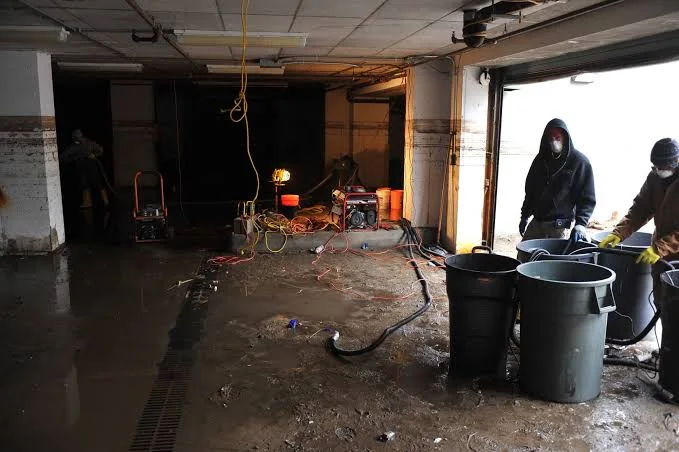
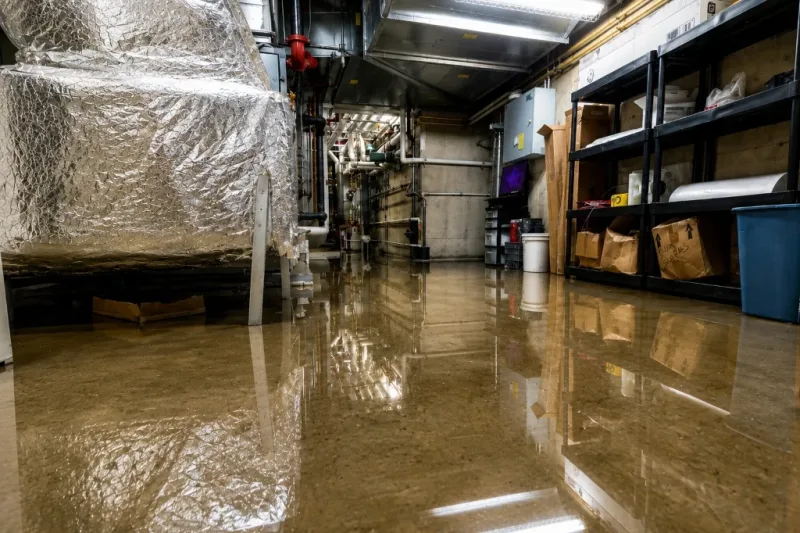
When subterranean water intrusion, failed sump pump systems, or torrential North Texas cloudbursts inundate your basement, rapid structural extraction is essential to prevent foundation movement and microbial colonization. Restore Crest deploys heavy-duty mobile pumping rigs, high-head electric submersible pumps, and industrial desiccant dehumidifiers across Dallas, Highland Park, Preston Hollow, and Lakewood within 45 minutes. We pump out standing floodwaters, eliminate silt, and dry subterranean concrete assemblies to certified baseline standards.

Speak directly with an on-duty field supervisor. Immediate dispatch across North Texas in under 45 minutes.
Understanding North Texas clay soil expansion, hydrostatic pressure differentials, and subterranean structural desiccation.
Subterranean water intrusion represents one of the most mechanically complex and structurally threatening emergencies a property owner in North Texas can confront. While full residential basements are less prevalent in Dallas than in northern climates, thousands of estate residences in Highland Park, University Park, Preston Hollow, and Lakewood feature finished subterranean basements, walk-out hillside basements, underground wine vaults, and lower-level media centers. Concurrently, Downtown Dallas high-rises, Uptown commercial towers, and industrial hubs throughout the Stemmons Corridor rely heavily on below-grade utility rooms, subterranean elevator banks, and below-ground parking garages. When high water tables, sudden storm deluges, or internal plumbing failures breach these lower elevations, thousands of gallons of water become trapped below grade, where gravity prevents natural drainage and demands immediate deployment from our certified Dallas water damage mitigation team.
The primary geological threat underlying North Texas basements is the behavior of regional soils. Dallas County rests upon dense, expansive vertisols colloquially designated as "black gumbo" clay, superimposed over geological formations of Austin Chalk and Eagle Ford Shale. During periods of drought, this clay contracts and forms fissures; during intense seasonal downpours, the soil absorbs moisture rapidly, swelling by up to thirty percent in volume. This volumetric swelling generates immense lateral hydrostatic pressure against subterranean concrete foundation walls, mortared masonry, and perimeter retaining assemblies. When external hydrostatic pressure exceeds the resistance of subterranean waterproofing membranes, water forces its way through cold joints, form-tie penetrations, hairline foundation cracks, and porous concrete footings. Left unmitigated, this pressure can deflect concrete retaining walls, displace masonry blocks, and trigger foundational cracking comparable to an uncontrolled foundation slab leak displacement.
Compounding the structural threat is the micro-climate created inside flooded subterranean spaces. Because basements lack natural cross-ventilation and solar heat gain, standing water cannot evaporate naturally. Instead, relative humidity spikes to 100% within hours, driving deep moisture vapor into porous concrete, structural sill plates, wall framing studs, and ceiling floor joists. Within twenty-four to forty-eight hours, stagnant subterranean moisture triggers rapid germination of toxic mold colonies including Stachybotrys and Aspergillus. If the floodwaters originated from exterior surface runoff or municipal storm sewer back-pressure, pathogenic microorganisms transform the basement into an active biological hazard, necessitating protocols aligned with our emergency biohazard cleanup division.
Property owners across our Dallas-Fort Worth service territory depend on Restore Crest because we do not simply drop domestic sump pumps and leave. Our IICRC-trained master restoration specialists approach every subterranean flood with industrial pumping capacity, psychrometric science, and structural engineering discipline. We calculate water volume, monitor foundation equilibrium, extract standing water with commercial high-head equipment, and establish positive pressure desiccating air envelopes that draw moisture from deep within concrete assemblies, in complete coordination with our comprehensive directory of certified emergency restoration solutions.
From mechanical equipment breakdowns to extreme weather surges, identifying the root mechanism is crucial for proper containment and extraction.
A subterranean sump pump is the primary defense line against rising water tables. However, sump pumps frequently fail at the height of severe storms due to electrical grid outages, mechanical float switches catching against pit walls, impeller blockages from accumulated silt, or failed check valves allowing pumped water to surge backward into the basin. When a primary pump ceases operation during heavy rain, a basement can accumulate several feet of water in less than two hours.
During severe multi-day storm systems around White Rock Lake, the Elm Fork Trinity River floodplain, and Turtle Creek corridors, the surrounding soil reaches complete water saturation. Unable to drain downward through dense clay, water creates outward hydraulic pressure against foundation walls. Water forces its way through basement floor-wall seams (cove joints), hairline stress fractures, and honeycombed concrete patches, leading to continuous fountain-like seepage across the slab.
When flash storms overload Dallas municipal storm sewers along arterial corridors like I-35E and US-75, the drainage main fills beyond capacity. Floodwater and raw sewage seek the lowest physical relief point in the municipal drainage network—which is almost always a residential basement floor drain, subterranean laundry drain, or below-grade commercial plumbing fixture. Technicians treat these surges under our rigorous emergency sewage backup decontamination standards.
Walk-out basements popular in North Dallas architectural designs feature below-grade exterior stairwells, egress window wells, and sub-grade patios. If exterior drain grates become clogged with leaves, mulch, or roof runoff from overloaded gutters, window wells transform into miniature reservoirs. The hydrostatic weight of the trapped water eventually blows out the window seal or cascades beneath French doors, rapidly submerging finished living spaces.
Mechanical rooms housing high-capacity 80-gallon water heaters, boiler loops, water softeners, and main copper or PEX water supply shutoffs are often located in basements. When an aged tank corrodes and ruptures, or a main line bursts under city water pressure, hundreds of gallons discharge continuously until isolated. In such instances, our team mobilizes alongside our emergency pipe burst extraction specialists to cut off the supply and stage high-volume pumping.
Subterranean perimeter footing drains (weeping tiles) installed around older Dallas foundations to channel subterranean water away from the structure frequently degrade over decades. Fine Texas clay silt washes through geotextile fabrics, choking the perforated pipes with mud and calcified sediment. With nowhere to exit, groundwater pools directly beneath the basement footing, building hydrostatic head pressure that forces water up through expansion joints.
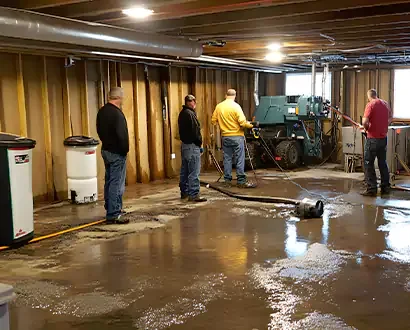
Authentic on-site photography from real residential and commercial basement flood recoveries throughout North Texas.
Flooded basements contain deadly invisible hazards including electrocution, structural wall collapse, and toxic bio-pathogens. Follow these strict guidelines before our arrival.
Standard consumer pumps and retail box fans cannot overcome subterranean lift head or desaturate thick concrete. We deploy professional commercial-grade extraction and psychrometric machinery.
Trailer-staged 3-inch and 4-inch solids-handling trash pumps capable of discharging 8,000 to 18,000 gallons per hour. Designed to pump mud, gravel, and organic debris without clogging or losing hydraulic prime.
Continuous-duty stainless steel and cast-iron submersible units engineered to overcome high vertical head pressure (lifting water up 20 to 30 feet from deep basement floors out to street-level drainage rigs).
Unlike standard refrigerant units that ice up in cool subterranean temperatures below 65°F, our industrial desiccant rotors absorb moisture directly from the air, dropping grains per pound (GPP) to ultra-low levels to force water out of concrete.
High-resolution infrared thermography detects cold thermal signatures of moisture hidden behind perimeter furred walls, beneath floating subfloors, and within foundation expansion joints without destructive exploration.
Every subterranean flood project follows the rigid parameters of IICRC S500 Standard for Professional Water Damage Restoration.
Upon arrival within 45 minutes, our lead restorer conducts a lockout/tagout electrical safety audit, checks for combustible gas or sewage vapors, and establishes safe egress routes. We utilize FLIR thermal cameras and digital thermo-hygrometers to establish baseline psychrometric readings, calculating the dew point, ambient relative humidity, and precise perimeter boundary of structural moisture migration.
We deploy truck-mounted extraction platforms or high-head electric submersible pumps into the deepest sump basin or lowest basement collection point. Bulk water is evacuated through heavy-wall discharge hoses routed to exterior municipal sanitary sewer drains. For catastrophic floods over 24 inches, our restorers perform controlled staged drawdown (pumping one to two feet per twelve hours) to equalize exterior clay hydrostatic pressure and prevent foundation wall failure.
Subterranean water intrusion leaves thick deposits of river silt, organic mud, and chemical contaminants. Our crews physically shovel and vacuum out wet sediment, bag saturated porous carpeting, underlayment padding, and unsalvageable baseboard trim. Drywall that has absorbed contaminated water is precision-cut two feet above the highest moisture waterline, eliminating capillary wicking into upper wall assemblies.
Concrete foundation walls frequently display efflorescence—white crystalline mineral salts pushed through masonry pores by hydrostatic pressure. We wire-brush and power-wash foundation surfaces, applying hospital-grade, EPA-registered broad-spectrum botanical biocides. This chemical wash penetrates microscopic masonry capillaries, neutralizing anaerobic bacteria, coliform, and microscopic fungi to inhibit spore colonies during drying.
We seal subterranean access points to create a controlled negative or positive drying envelope. Industrial desiccant dehumidifiers duct super-dry air into the basement, while high-velocity axial air movers circulate turbulent airflow across concrete slabs and exposed wood framing. By maintaining a steep vapor pressure differential between saturated materials and the ambient air, bound water molecules are continuously drawn out of structural members and exhausted outdoors.
Mitigation is never considered complete based on visual inspection alone. Daily psychrometric data logs record grains per pound (GPP), relative humidity, and structural wood moisture content (WMC). Equipment remains active until concrete slab moisture vapor emission rates (MVER) and framing moisture levels drop below 12% equilibrium moisture content (EMC), at which point we issue a certified IICRC S500 Dry Standard Clearance Report.
Different subterranean architectures present distinct material vulnerabilities and mitigation requirements. Restore Crest provides customized protocols across three primary sectors.
In Highland Park, Preston Hollow, and University Park, luxury subterranean spaces frequently house state-of-the-art home theaters, climate-controlled wine cellars, custom hardwood millwork, and imported stone flooring. When a plumbing failure or foundation seepage floods these spaces, standard destructive demolition can destroy hundreds of thousands of dollars in architectural finishes.
Our preserve-in-place methodology deploys negative-pressure floor mat injection systems that extract trapped moisture directly through solid hardwood tongue-and-groove joints without floor removal. We utilize targeted cavity injection dryers inserted behind custom baseboards, gently desiccating wall assemblies without cutting into luxury wood paneling or custom acoustic wall treatments.
Historic residences in Lakewood, East Dallas, and Oak Cliff often feature deep unfinished concrete or limestone masonry cellars housing furnaces, water heaters, central vacuum units, and family storage. When heavy rains cause stormwater seepage through old stone foundation walls, water accumulates on raw concrete slabs, saturating stored cardboard boxes and exposing structural floor joists above to intense humidity.
We deploy high-volume trash extraction, safely elevate or salvage mechanical equipment, and perform intensive bio-cleansing on stone and brick masonry. Saturated framing timbers are treated with preventative anti-fungal barrier coatings to protect the home’s first-floor subflooring from secondary fungal rot, coordinating if necessary with our subfloor and ceiling moisture extraction teams.
Commercial complexes in Downtown Dallas, Uptown office corridors, and hospital complexes near Parkland Memorial Hospital and Baylor University Medical Center feature multi-level subterranean parking decks, boiler rooms, and critical telecom infrastructure. A major storm surge or water main rupture can flood elevator pits, disable fire sprinkler pumps, and submerge vehicular traffic lanes.
In these critical operational facilities, our commercial large-loss water restoration division deploys multi-rig high-flow pumping packages. We maintain temporary power generation, pump submerged elevator pits to allow municipal lift inspections, and implement industrial air scrubbers to guarantee facility continuity and tenant safety.
We eliminate financial uncertainty during property crises. You receive a complete line-item estimate detailing every pump, air mover, and technician hour before work commences. No hidden dispatch charges, no billing surprises.
Water depth under 2 inches across unfinished concrete slabs. Includes rapid diagnostic moisture mapping, standing water extraction, antimicrobial application, and a 3-day commercial LGR dehumidifier and airflow package.
Water depth 2 to 12 inches impacting finished drywall, carpet, and baseboards. Includes high-head pumping, carpet extraction, baseboard removal, precision flood cuts, and industrial desiccant drying.
Severe flooding over 12 inches, subterranean commercial parking decks, or municipal sewer surcharges. Involves high-capacity trash pumping rigs, biohazard sanitization, and large-scale desiccant trailer systems.
| Mitigation Line Item | Technical Scope of Work | Deployment Duration | Transparent Flat Rate |
|---|---|---|---|
| Emergency Subterranean Triage & Thermal Mapping | 45-min arrival, FLIR thermography, electrical safety audit, atmospheric check & baseline moisture mapping | 1 - 2 Hours | $295 - $450 |
| High-Volume Trash Pumping (Over 12" Water) | Industrial 3" to 4" solids-handling trash pump deployment, heavy-wall discharge routing & staged drawdown | 3 - 6 Hours Active | $850 - $1,650 |
| Electric Submersible & Truck-Mounted Extraction | High-vacuum surface water extraction pulling free water from concrete, subfloors, and sumps down to 1/8" | Per 1,000 sq. ft. | $0.75 - $1.45 / sq. ft. |
| Silt Muck-Out & Biohazard Antimicrobial Wash | Manual shoveling and disposal of river sediment/mud, followed by hospital-grade EPA biocide pressure scrubbing | Full Basement Scope | $450 - $1,150 |
| Industrial Desiccant / Commercial LGR Dehumidifiers | High-capacity moisture absorption units designed for low subterranean temperatures, dropping GPP below 30 | Daily Unit Rate | $145 - $265 / day / unit |
| Controlled Drywall Relief Cuts & Cavity Aeration | Precision flood cuts 2 feet above waterline, insulation extraction, and stud cavity airflow sanitization | Per Linear Foot | $8.50 - $14.00 / lin. ft. |
All pricing backed by our 100% Upfront Pricing Guarantee. Every scope item is presented in writing and approved before our mitigation crew powers on equipment. Read verified customer experiences on our reviews and testimonials page.
"Pumping a flooded basement is an engineering task, not just a matter of running hoses. If you pump out a deeply flooded basement too quickly while the surrounding North Texas clay soil is waterlogged, the lateral hydrostatic pressure can literally collapse your concrete foundation walls inward. We calculate soil saturation, execute controlled staged drawdown, and dry subterranean materials to certified structural equilibrium. You receive upfront itemized pricing with zero guesswork."
Authoritative, clear answers to essential questions regarding subterranean pumping, foundation hydrostatic pressure, mold risks, and upfront costs across Dallas, TX.
Our emergency mobile pumping units arrive on-site across Dallas County, Highland Park, University Park, and Collin County in under 45 minutes from your emergency call. Once electrical and structural safety inspections are complete, our heavy-duty extraction rigs and submersible pumps begin discharging standing water at rates up to 10,000 gallons per hour. For minor to moderate floods (under two feet), standing water is evacuated within two to four hours of arrival.
When extensive rainfall saturates the expansive black clay soil surrounding your foundation, water creates massive outward hydrostatic pressure against basement walls. The standing water inside your basement acts as an equalizing counter-force, holding the foundation walls outward. If you rapidly pump out several feet of water while the surrounding ground is waterlogged, the external soil pressure can cause foundation walls to bow inward, crack severely, or collapse entirely. Restore Crest calculates soil moisture levels and executes calibrated, staged drawdown to safeguard your structural foundation.
The four primary causes of sump pump failure during storms are electrical power outages, mechanical float switch failure, check valve rupture, and impeller clogging. Intense thunderstorms regularly knock out grid electricity when pumps are needed most. Mechanical float switches can catch on power cords or basin walls, preventing the motor from engaging. If the discharge line check valve fails, pumped water flows right back into the pit. Finally, fine sediment washed from clay soils can choke the impeller, causing the electric motor to overheat and trip the breaker.
Under normal subterranean temperatures and relative humidity above 70%, fungal spores begin germinating on damp organic substrates (drywall paper, cardboard boxes, carpet padding, and wood framing) within 24 to 48 hours. In an enclosed basement without ventilation, humidity quickly hits 100%, accelerating rapid microbial colonization. Immediate extraction, antimicrobial washing, and continuous desiccant dehumidification from our certified mold remediation team are mandatory within the first 24 hours to halt colonization.
Yes, provided that the floodwater is Category 1 clean water (such as a burst supply line) and extraction begins within the initial 24 to 48 hours. We apply industrial vacuum injection mats directly over the wet wood floorboards. The negative vacuum pressure pulls bound moisture from the subfloor up through the plank seams without tearing out expensive custom hardwood. If the water involves storm runoff or sewage backflow, porous flooring must be removed to eliminate trapped bio-contaminants.
Efflorescence is the chalky, white crystalline mineral deposit that forms on concrete, block, or brick walls when water seeps through from the exterior. As water travels through porous concrete, it dissolves water-soluble mineral salts. When the water reaches the interior basement air and evaporates, it leaves the mineral salt crystals behind on the wall surface. While non-toxic, efflorescence is a conclusive diagnostic indicator of ongoing lateral hydrostatic moisture seepage that requires professional mechanical desiccation.
Standard residential dehumidifiers are small consumer units rated for 30 to 50 pints per day under ideal warm conditions. In subterranean environments where temperatures hover around 60°F to 65°F, consumer units freeze up and frost over their cooling coils. Furthermore, concrete foundation slabs hold thousands of pounds of bound water that require industrial desiccant dehumidifiers capable of moving hundreds of cubic feet of dry air per minute and lowering ambient grains per pound (GPP) below 30.
In nearly all natural flood scenarios, yes. Water entering from the ground, overflowing window wells, or foundation seepage washes lawn fertilizers, pesticides, silt, and soil bacteria into the structure, classifying it as Category 2 (grey water). If the intrusion involves stormwater backing up through basement floor drains, it is classified under IICRC S500 as Category 3 (black water), containing pathogenic microorganisms and hazardous coliform bacteria requiring bio-containment.
Under professional IICRC S500 psychrometric drying protocols, structural drying typically requires three to five days. While bulk standing water is pumped out within hours, dense masonry materials such as concrete slabs, block footings, and structural timber plates take several days to release bound deep moisture. Our technicians monitor and log digital moisture levels daily until materials reach verifiable dry equilibrium.
Yes, absolutely 100%. We provide a fully transparent, itemized written estimate detailing every line item—extraction rates, equipment deployments, antimicrobials, and labor hours—before our crew powers on any machinery. You have total financial transparency and control with zero surprise invoices. Reach out to our main team at Restore Crest Dallas headquarters for immediate assistance.
Restore Crest operates mobile rapid-response pumping units positioned along key DFW highway corridors for 45-minute guaranteed arrival.
Every hour floodwater stands in your basement, hydrostatic pressure builds against foundation walls and secondary microbial colonization spreads. Speak directly with an on-duty Restore Crest Dallas restoration supervisor right now. We arrive in under 45 minutes with industrial-grade pumping rigs.
Provide your incident details below. Our on-duty field supervisor will contact you immediately.