Active overhead roof leaks, punctured roof decks, and failing flashing assemblies funnel torrential rainwater into attic insulation and ceiling assemblies within minutes. When saturated blown-in cellulose or fiberglass holds five times its weight in water, ceiling drywall dissolves around fasteners and collapses without warning. Restore Crest deploys rapid 45-minute emergency structural mitigation across Dallas, Preston Hollow, Lakewood, and Lake Highlands. We install immediate controlled drainage relief, extract saturated attic insulation, map hidden moisture boundaries using thermal infrared imaging, and deploy industrial LGR drying systems to protect your home with 100% upfront flat-rate pricing.

Speak directly with an on-duty field supervisor. Immediate dispatch across North Texas in under 45 minutes.
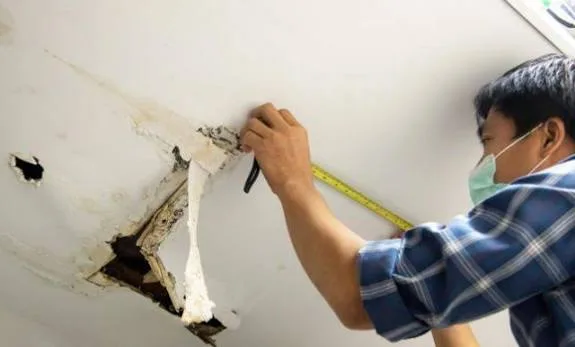
Why active roof leaks create extreme structural hazards, saturated insulation sponge reservoirs, and rapid ceiling drywall dissolution across Dallas properties.
An active roof leak in a North Texas residential or commercial building is rarely an isolated drip. Because water follows the path of least resistance across pitch angles, gravity pulls driving exterior rainwater through damaged shingles, failing valley metal, rusted pipe jacks, or storm-punctured OSB roof sheathing. Water traverses horizontal rafters and ceiling joists dozens of feet away from the initial exterior penetration point before pooling in low-lying attic cavities. Once trapped above living spaces, this overhead deluge encounters dense layers of blown-in cellulose or loose fiberglass attic insulation. Blown-in insulation behaves like a massive mechanical sponge, absorbing up to five times its dry weight in water before a single visible droplet penetrates the drywall ceiling below.
Standard residential ceiling drywall measures one-half inch in thickness and weighs approximately 1.6 pounds per square foot under normal dry conditions. However, when blown-in cellulose or batt fiberglass above the ceiling becomes saturated by persistent roof intrusion, the combined dead load spikes dramatically to fifteen to twenty-five pounds per square foot. Wet gypsum core softens rapidly under hydrostatic pressure, turning into a chalky paste. The structural paper facers delaminate, and drywall screws pull completely through the softened gypsum core. Without immediate emergency intervention from our specialized ceiling water damage restoration technicians, the water-logged ceiling will suddenly give way, dumping hundreds of pounds of contaminated water, wet insulation, and fractured gypsum onto hardwood flooring, furniture, and personal property below.
The meteorological conditions across Dallas County drastically amplify this physical degradation. During severe spring supercells or intense summer squalls along the I-635 Lyndon B. Johnson Freeway and US-75 Central Expressway corridors, convective storms drop torrential rain accompanied by gale-force straight-line winds and hail strikes. When tree limbs fracture hip roofs or wind shear strips ridge vents, water intrusion happens at immense volume. In North Texas summer heat, an attic space routinely exceeds 130 to 140 degrees Fahrenheit. When exterior moisture combines with intense ambient attic heat, the attic transforms into an accelerated incubator for microbial amplification. If saturated insulation is not extracted and structural timber framing is not dried according to rigorous psychrometric protocols within 24 to 48 hours, active fungal growth takes root, requiring intensive certified mold remediation and antimicrobial wash across the entire roof truss assembly.
At Restore Crest, our emergency disaster crews stationed at 1910 Pacific Ave in Downtown Dallas are mobilized around the clock to stop active overhead water intrusion. Our response vehicles are engineered for immediate rapid deployment across Dallas, Preston Hollow, Highland Park, University Park, Lakewood, and Lake Highlands. From the second our dispatch team answers your call at +1 (214) 491-5611, our objective is absolute structural preservation: we establish controlled ceiling hydraulic relief to prevent drywall collapses, mechanically extract saturated insulation, map hidden moisture migration pathways with high-resolution FLIR radiometric thermal cameras, and dry roof decking back to structural baseline standards, backed by our comprehensive suite of emergency water damage restoration services and certified property disaster solutions.
Each structural roof component presents distinct failure mechanisms under severe weather, thermal expansion, and mechanical wear.
Roof valleys funnel immense volumes of runoff during torrential Dallas downpours. When galvanized metal valley liners rust or step flashing along second-story brick walls separates due to thermal expansion, driving water bypasses shingles and flows directly onto raw plywood decking. Water migrates along rafters down into exterior wall cavities, damaging wall studs and drywall before pooling in living areas.
Every penetration through a roof deck requires an elastomeric rubber boot collar. The relentless North Texas summer sun bakes neoprene collars until they crack, split, and shrink. During sudden thunderstorms, rainwater cascades down the exterior of PVC plumbing pipes directly into the attic center, drenching insulation and ceiling drywall adjacent to bathrooms and utility rooms.
Severe thunderstorm squalls across North Texas generate violent hail and straight-line winds exceeding seventy miles per hour, frequently requiring our emergency storm damage restoration and tarping crews. Hail stones fracture fiberglass asphalt mats, while wind shear tears ridge caps. Overhanging post oak or pecan limbs snap onto roof trusses, puncturing decking and exposing homes to massive rainwater inundation.
While rainwater begins as clean atmospheric precipitation, the instant it washes across asphalt shingles, bird droppings, atmospheric soot, dust, and rodent droppings in attic crawlspaces, it degrades immediately into Category 2 grey water or Category 3 black water. When wet cellulose insulation remains trapped in a hot attic, fungal spores and bacterial colonies multiply exponentially. Extracting saturated insulation with industrial HEPA vacuum equipment and sanitizing structural rafters with EPA-registered botanical antimicrobials is mandatory under IICRC S500 standards to ensure indoor air quality remains safe throughout our North Texas service areas.
Authentic jobsite photography from residential and commercial roof leak emergency responses across the Dallas-Fort Worth metroplex.
 Preston Hollow • Estate Ceiling
Controlled Cutout
Preston Hollow • Estate Ceiling
Controlled Cutout
Technicians performing straight-edge joist-centered flood cuts to relieve trapped water weight safely, preventing catastrophic drywall collapse and isolating damaged gypsum.
 Lake Highlands • Attic Moisture Scan
Thermal Moisture Map
Lake Highlands • Attic Moisture Scan
Thermal Moisture Map
Non-destructive thermal imaging revealing lateral water migration paths along rafters and joists, uncovering hidden insulation saturation before fungal colonization occurs.
 Lakewood • Cavity Drying Setup
LGR Psychrometrics
Lakewood • Cavity Drying Setup
LGR Psychrometrics
Industrial Low Grain Refrigerant units removing bound moisture from ceiling joists and roof trusses, reducing relative humidity below forty percent to halt mold growth.
 North Dallas • Attic Joist Airflow
High-Velocity Airflow
North Dallas • Attic Joist Airflow
High-Velocity Airflow
Strategic placement of multi-angle 3,000 CFM axial air movers driving laminar airflow directly into overhead wood framing to speed psychrometric evaporation rates.
 University Park • Hardwood Floor Salvage
Flooring Salvage
University Park • Hardwood Floor Salvage
Flooring Salvage
Commercial vacuum extraction mats extracting water that cascaded from ceiling leaks onto antique wood flooring, preventing cupping and saving planks without tear-outs, coordinated with our hardwood floor water restoration division.
 Dallas • Wall Cavity Desiccation
Wall Cavity Drying
Dallas • Wall Cavity Desiccation
Wall Cavity Drying
Positive-pressure drying systems forcing desiccated air behind wallboards where water ran down framing from roof penetrations, drying studs in place without full teardowns.
Before our 45-minute emergency crew arrives, taking correct safety measures prevents electrical shock, personal injury, and catastrophic ceiling collapses.
Executing rigorous IICRC S500 protocols to arrest overhead water intrusion, extract saturated attic materials, and restore structural framing back to certified equilibrium.
Our rapid response crew stages heavy-duty containment tarps and industrial catch basins beneath the leak. If ceiling drywall is visibly swelling with water, our lead technician punctures controlled drain ports to relieve hydraulic weight. Concurrently, exterior crews deploy weather-resistant, lumber-batten-secured 12-mil poly tarps over roof penetration points to halt ongoing rainwater intrusion immediately, just as detailed on our IICRC-trained technician standards page.
Water travels laterally along sloped rafters before dripping down. Using high-resolution radiometric FLIR thermal imaging cameras, non-invasive radio frequency moisture meters, and calibrated hammer-probe moisture sensors, we map the exact physical perimeter of trapped moisture across roof decking, attic framing, and interior ceilings, leaving zero hidden moisture pockets unaddressed.
Saturated blown-in cellulose or fiberglass cannot be salvaged and will breed mold if left in place. We position heavy-duty truck-mounted insulation vacuum rigs with HEPA filtration outside the home. Industrial extraction hoses routed through attic access points extract tons of soggy insulation directly into sealed waste containment trucks, preventing toxic dust or biological spores from entering your conditioned living space.
Damaged, dissolved, or sagging ceiling drywall is excised using surgical flood cuts centered directly along joist centerlines. Our technicians erect negative-pressure plastic containment barriers and floor protection before making clean cuts. This eliminates jagged edges, protects intact ceiling sections, simplifies re-drywalling, and provides open ventilation into saturated overhead cavities.
Unfinished wooden roof rafters, OSB roof sheathing, and ceiling joists that were exposed to exterior water are treated with hospital-grade, EPA-registered botanical antimicrobial washes. This neutralizes active mold spores, eliminates wood-decay fungi, and eradicates foul musty odors, guaranteeing that the attic structural envelope remains sterile and safe for your family.
We deploy commercial Low Grain Refrigerant (LGR) dehumidifiers paired with high-velocity axial air movers angled into joist cavities. These industrial units cycle thousands of cubic feet of air per hour, extracting bound moisture out of structural wood framing until moisture content reaches regional equilibrium standards below 15%, fully documented with psychrometric data logs.
Comparing water intrusion behavior, substrate composition, and psychrometric mitigation methodologies across property types in Dallas County.
Residential homes throughout Preston Hollow, Lakewood, and Highland Park typically feature asphalt architectural shingles, standing seam metal, or clay barrel tiles pitched over OSB roof decking with vented attic cavities.
Commercial buildings, retail plazas, and medical clinics in Downtown Dallas, Stemmons Corridor, and Las Colinas rely on low-slope TPO, PVC, or modified bitumen membranes over polyisocyanurate (polyiso) insulation boards and corrugated steel decks, managed by our commercial large-loss water disaster team.
We operate with complete financial integrity. You receive an itemized, clear, flat-rate estimate before any work begins. No surprises, no hidden line items, and no unexpected add-ons.
Immediate 45-minute emergency dispatch to secure active roof punctures, halt ongoing rainwater entry, and perform controlled interior drainage relief.
Full structural mitigation for homes suffering attic insulation saturation, wet ceiling drywall, and rafter moisture from roof leaks.
Customized disaster recovery for multi-level estates, commercial complexes, retail shopping centers, and large-scale roof collapses.
All pricing is backed by our 100% Upfront Direct Pricing Guarantee. We explain every line item clearly in writing before work begins. We accept all major credit cards, corporate checks, and wire transfers. Verified by our five-star track record on our customer testimonials and reviews page.

"When overhead rainwater compromises a roof deck in Dallas, every minute counts. Saturated blown-in attic insulation acts like an immense sponge, holding hundreds of pounds of water directly over your family's living areas until the ceiling fasteners tear through. My direct commitment to every North Texas homeowner is immediate: our emergency crews arrive within forty-five minutes, relieve trapped ceiling hydraulic weight before a collapse happens, vacuum out saturated insulation, and dry structural rafters back to dry standard baselines. We provide 100% upfront flat-rate itemized estimates before turning on our equipment, so you always have total clarity and peace of mind."
Technical answers to essential questions regarding ceiling collapse risks, saturated insulation removal, thermal mapping, drying durations, and upfront flat rates in Dallas, TX.
Our average emergency dispatch response time is under forty-five minutes across Dallas County and the DFW metroplex. We maintain pre-staged emergency response vehicles equipped with heavy-duty 12-mil reinforced roof tarps, lumber battens, industrial insulation extraction vacuums, and commercial LGR dehumidifiers positioned near primary highway arteries including Central Expressway US-75, Stemmons Freeway I-35E, and the I-635 LBJ Freeway. When storm deluges or sudden roof failures strike, our crews mobilize immediately to stop water intrusion before catastrophic ceiling failure occurs.
A bulging ceiling is a serious structural hazard. Wet drywall and saturated cellulose insulation can drop hundreds of pounds of debris without warning. Immediately place large plastic bins or buckets directly beneath the sag. Then, standing safely to one side, carefully puncture the center of the drooping drywall blister with a screwdriver or nail to create a controlled drain hole. This relieves hydraulic weight gradually, preventing a violent full-sheet drywall collapse. Turn off circuit breakers to overhead lights in that room, and immediately call our 24/7 emergency dispatch line at +1 (214) 491-5611.
Under IICRC S500 standards, saturated blown-in cellulose and loose fiberglass insulation cannot be dried in place. Cellulose is composed of finely shredded recycled paper treated with fire retardants; when wet, it compacts into a dense, soggy mass that traps moisture against ceiling joists and loses all thermal R-value. In warm Dallas attics, wet cellulose breeds dense mold colonies within twenty-four to forty-eight hours. We use truck-mounted HEPA vacuum extraction rigs to remove all saturated insulation safely without contaminating your indoor living space.
Roof leaks routinely enter through compromised ridge caps, valley flashings, or pipe jacks and travel thirty feet along angled rafters before accumulating on ceiling drywall. We utilize high-resolution radiometric FLIR infrared thermal cameras to detect the evaporative temperature signatures of hidden water pathways. We pair thermal imaging with calibrated deep-pin and non-destructive radio frequency moisture meters to trace the exact migration path from the exterior roof deck penetration to the lowest pooling point, ensuring every saturated wood member is identified and dried.
Under standard psychrometric conditions, completely drying exposed attic framing, ceiling joists, and remaining drywall typically requires three to five days of active commercial dehumidification. Restore Crest deploys commercial Low Grain Refrigerant (LGR) dehumidifiers paired with directional axial air movers aimed upward into joist bays. Our lead technicians take daily moisture readings of structural timber, comparing them against regional North Texas equilibrium moisture standards (below 15%) before equipment is decommissioned.
Rainwater begins as clean atmospheric water, but as soon as it traverses weathered asphalt shingles, roof flashing, accumulated dirt, atmospheric particulate matter, bird droppings, and rodent activity in attic cavities, it is classified as Category 2 grey water or Category 3 black water under IICRC guidelines. It carries biological contaminants and bacterial agents. That is why our technicians treat all exposed rafters and joists with hospital-grade, EPA-registered botanical antimicrobial agents to eliminate biological risks.
Yes, provided conditions allow safe ladder staging and there are no active lightning strikes or tornadic wind gusts. If violent lightning makes ascending the roof momentarily unsafe, our technicians immediately secure the interior envelope. We stage industrial catch basins, perform controlled ceiling punctures to relieve hydraulic weight, extract pooling floor water, and ascend to install our lumber-batten-secured 12-mil poly tarp the instant dangerous lightning clears, as detailed on our emergency storm tarping division page.
Yes, 100%. Restore Crest operates on an uncompromising policy of upfront, transparent, flat-rate line-item pricing. Before our crew installs a roof tarp, cuts drywall, or turns on commercial dehumidifiers, our field supervisor provides a comprehensive written scope of work detailing all equipment, extraction units, and labor charges. You approve the exact cost upfront with zero hidden fees or surprise billings. Learn more about our company on our about Restore Crest page.
Preventing mold growth requires rapid psychrometric environmental control. In the North Texas climate, mold spores germinate on wet organic cellulose (wood rafters, drywall paper facers) within 24 to 48 hours. We rapidly drop attic and living space relative humidity below 40% using commercial LGR dehumidifiers, vacuum extract wet insulation, and apply an EPA-registered broad-spectrum botanical antimicrobial wash across all exposed structural lumber, coordinated directly with our dedicated Dallas mold remediation division.
We provide full emergency roof leak water damage repair and attic drying coverage across Dallas County, Collin County, Denton County, and Tarrant County. Our rapid-dispatch teams routinely service Downtown Dallas, Uptown, Highland Park, University Park, Preston Hollow, Lakewood, Lake Highlands, Plano, Frisco, McKinney, Irving, Carrollton, and Fort Worth. Review our complete coverage territory on our DFW service areas page.
Stationed near major Dallas transport arteries for guaranteed emergency arrival within forty-five minutes of dispatch.
Every minute that passes allows overhead rainwater to soak deeper through attic insulation, dissolve ceiling drywall screws, rot wooden rafters, and spark secondary mold colonies. Contact our on-duty disaster operations lead right now. Our crews arrive across Dallas County within forty-five minutes with heavy-duty roof tarps, insulation extractors, and commercial drying rigs.
Fill out the details below. Our on-duty disaster recovery supervisor will contact you immediately.