When sub-zero North Texas polar plunges freeze uninsulated attic plumbing, exterior wall water lines, or commercial fire sprinkler risers, expanding ice generates catastrophic pressure exceeding 2,000 PSI that fractures pipe walls. The true disaster strikes during the subsequent thaw, releasing hundreds of gallons of pressurized municipal water per hour across ceilings, wall cavities, and hardwood floors. Restore Crest stages rapid-deployment extraction rigs, Injectidry hardwood rescue mats, and industrial desiccant dehumidifiers across Dallas, Highland Park, University Park, Preston Hollow, Plano, and Frisco within 45 minutes to halt structural degradation, extract standing deluge, and dry structural assemblies with zero unnecessary demolition.

Speak directly with an on-duty field supervisor. Immediate dispatch across North Texas in under 45 minutes.

Understanding why sub-freezing North Texas polar plunges split pressurized copper, PEX, and CPVC supply lines and why catastrophic flooding peaks when temperatures rise above freezing.
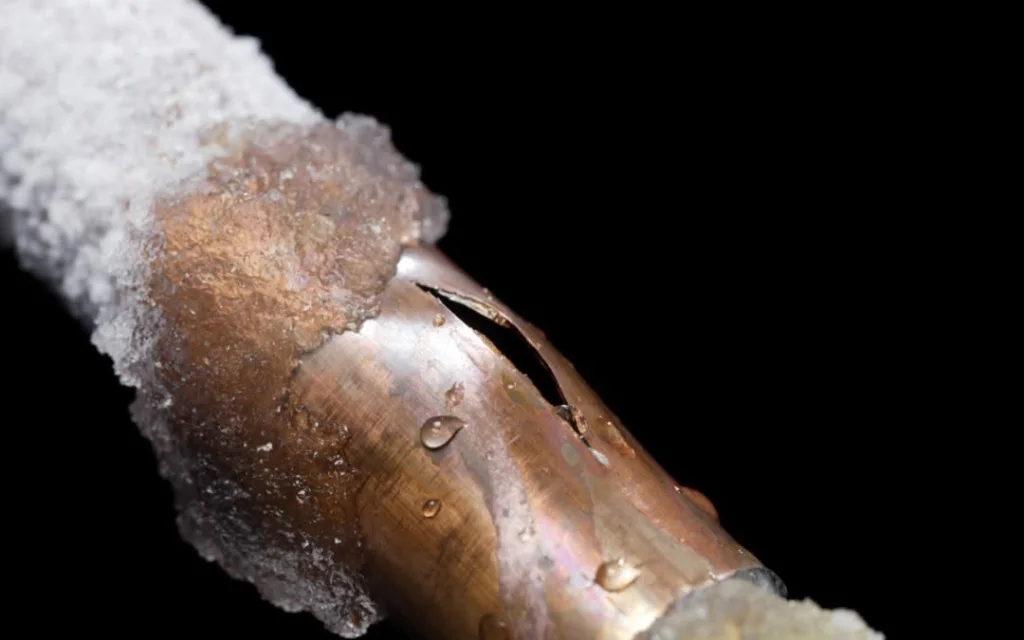
When arctic cold fronts descend across North Texas, unconditioned attics, cantilevers, and exterior wall cavities rapidly lose thermal equilibrium. At 32°F (0°C), liquid water transitions into crystalline hexagonal ice (ice Ih), expanding by 9% in volumetric mass.
Because liquid water is incompressible, expanding ice plugs act as hydraulic pistons between the freeze and closed faucets. Pressure surges from normal 60 PSI to over 2,000–4,000 PSI, generating extreme circumferential radial hoop stress.
Hoop stress forces copper and plastic walls to stretch, thin, and split lengthwise or shear fittings off soldered elbows. Our emergency burst pipe cleanup team deploys immediately to isolate ruptured supply runs.
As Dallas temperatures climb above 32°F, ice plugs liquefy, releasing 10–20 GPM (600–1,200 gallons/hour) through the split. Saturated insulation and drywall collapse without immediate extraction from our water damage restoration team.
Different plumbing materials react uniquely to sub-zero freezing stresses, hydraulic shockwaves, and rapid thermal cycling across Dallas building envelopes.
Commonly installed across established Dallas neighborhoods such as Highland Park, University Park, Preston Hollow, and Lakewood, copper plumbing possesses minimal radial elasticity. Thin-walled Type M copper splits readily along seam lines when trapped hydrostatic pressure crosses 2,500 PSI. Rigid soldered 90-degree elbows and tees frequently separate under axial ice expansion, creating high-volume leaks inside attic floor joists and concealed wall chases.
Standard in newer residential construction across Frisco, Plano, North Dallas, and Celina, PEX tubing offers superior radial elasticity and thermal memory, expanding up to 300 percent of its diameter without rupturing. However, PEX systems are highly vulnerable at their connection points. Metallic brass crimp rings, cold-expansion rings, and plastic fittings experience differential thermal contraction, causing fittings to crack or PEX tubing to slip entirely off barbed connectors under ice pressure.
Widely utilized in multifamily developments and 1990s suburban homes, CPVC undergoes severe polymer degradation and embrittlement over years of hot water exposure and attic heat. When exposed to sub-zero freeze events, embrittled CPVC loses virtually all impact tolerance. Rather than an elastic stretch or localized pinhole, freezing ice causes CPVC pipes to shatter violently along extensive runs, discharging hundreds of gallons across foundation slabs and subfloors.
Traditional North Texas building designs prioritize summer heat rejection, leaving plumbing runs critically exposed when arctic cold domes stall over Dallas County.
Across North Dallas, Plano, Richardson, and Carrollton, domestic lines frequently run over ceiling joists beneath vented roof decks. Insulation placed beneath pipes isolates them from warm indoor air, causing freeze-splits in 3–6 hours.
In custom homes throughout Highland Park, University Park, and Preston Hollow, supply lines running inside 2x4 exterior walls absorb severe cold through masonry brick veneer during high-wind winter storms.
Along Interstate 35E, Central Expressway (US-75), and the Dallas North Tollway, commercial facilities face severe risk in unheated plenum spaces, parking garages, and multi-tenant riser chases.
Follow these immediate field-tested protocols during a freeze-thaw plumbing event to protect building occupants, avoid catastrophic electrical hazards, and minimize structural loss.
Our scientific structural drying framework deployed on every emergency Dallas freeze-thaw plumbing failure to eliminate moisture, prevent mold, and salvage original architecture.
Upon arriving at your Dallas property in under 45 minutes, technicians confirm full isolation of the ruptured plumbing line, utilizing commercial curb stop keys and secondary branch cutoffs. We perform lockout/tagout procedures on affected electrical sub-circuits, conduct non-contact voltage testing across wet surfaces, and establish safety containment zones to protect building occupants from structural hazards.
Our mobile rigs deploy high-cfm truck-mounted vacuum extractors and heavy-duty submersible pumps capable of removing hundreds of gallons per minute. We utilize weighted extraction rovers across carpeted surfaces and weighted squeegee wands over porcelain tile, terrazzo, and concrete slabs to pull standing water from subfloor substrates before vertical wicking saturates drywall.
Water cascades from burst attic lines straight down internal stud bays, pooling on bottom sill plates behind finished baseboards. Technicians carefully detach trim with non-marring pry tools and drill 5/8-inch concealed weep holes at the base of the drywall. This relieves hydrostatic pooling, drains trapped water pockets, and creates air exchange access ports without requiring destructive drywall demolition.
To rescue solid oak, walnut, and engineered wood flooring from irreversible cupping, we deploy specialized Injectidry floor vacuum panels. High-pressure negative vacuum mats seal tightly over saturated floorboards, pulling trapped moisture directly out of the wood grain and subfloor plywood beneath. Learn more about our specialized systems on our hardwood floor water damage restoration page.
We deploy industrial Low Grain Refrigerant (LGR) dehumidifiers alongside high-velocity axial air movers configured in a vortex pattern across all saturated zones. LGR units reduce indoor vapor pressure to ultra-dry conditions below 30 grains per pound (GPP), accelerating evaporation of bound moisture from structural 2x4 framing, subflooring, and ceiling joists before wood fibers degrade.
All affected structural assemblies receive an electrostatic application of hospital-grade, EPA-registered botanical antimicrobial agents (active thymol) to eradicate airborne fungal spores and prevent microbial growth. If saturation was left unaddressed prior to our arrival, technicians transition seamlessly to certified Dallas mold remediation standards. We verify complete dryness with FLIR thermal imaging and digital pin meters.
Why premature demolition is costly and destructive, and how our advanced psychrometric drying protocols save original architectural finishes.
When an attic or wall pipe ruptures during a Dallas freeze, water rapidly finds its way into high-end architectural materials throughout the home. In prestigious neighborhoods like Bluffview, Devonshire, Lakewood, and Highland Park, homes feature antique wide-plank oak, custom quarter-sawn walnut, and custom painted millwork that cannot easily be replaced with off-the-shelf modern building materials. Uncertified disaster contractors often arrive with sledgehammers, gutting drywall down to studs, tearing out original hardwood floors, and ripping out built-in cabinetry without attempting scientific drying. At Restore Crest, our philosophy is anchored in material science: we preserve and restore original building assemblies in place whenever structurally feasible.
Hardwood flooring absorbs moisture in distinct cellular phases. Free water first occupies the cell lumens (the hollow cellular cavities of the wood), while bound water enters the cellulose cell walls, causing the wood to swell. Because the underside of the floorboard in contact with wet subfloor absorbs moisture much faster than the polyurethane-sealed upper surface, an asymmetric expansion gradient develops. This forces the edges of the plank upward, a condition known as cupping. If addressed within 24 to 48 hours of water intrusion, cupped hardwood flooring is completely salvageable. By applying continuous negative vacuum pressure through our sealed floor panels, we draw free moisture out from beneath the floorboards. As subfloor moisture content drops and cellular equilibrium is restored, the physical tension relaxes, allowing boards to return to their original flat profile without destructive sanding or replacement.
Similarly, interior wall assemblies can frequently be saved without destructive tear-out. Rather than cutting four-foot drywall flood cuts across an entire finished room, our technicians utilize directed positive and negative cavity drying. By removing decorative baseboards and injecting dehumidified, heated air directly into stud bays through concealed micro-openings, we create rapid vapor pressure differentials that drive bound moisture out of framing lumber and the back paper face of drywall. Once dry, baseboards are reinstalled seamlessly, saving homeowners thousands of dollars in drywall replacement, taping, texturing, and custom painting costs. Discover our full background and company values on our about Restore Crest page.
We never activate drying equipment without presenting a complete, itemized, flat-rate estimate in writing. No hidden emergency fees, no surprise dispatch markups, and no open-ended hourly billing.
Designed for localized pipe bursts contained to a single room or utility area with minimal standing water.
Ideal for multi-room freeze failures involving saturated drywall, subfloors, and cupped hardwood flooring.
For catastrophic attic pipe bursts releasing 500+ gallons across multiple floors, ceilings, and ductwork.
| Service Activity | Engineering Deliverables & Equipment | Standard Duration | Transparent Flat Rate |
|---|---|---|---|
| Emergency Pipe Freeze Assessment & Thermal Scan | 45-minute on-site arrival, FLIR high-res infrared moisture mapping, main shut-off confirmation, and written itemized drying plan | 1 - 2 Hours On-Site | $295 - $450 |
| Truck-Mounted High-Volume Water Extraction | Commercial vacuum extraction of standing deluge across flooring, weighted rover passes, and initial surface stabilization | 2 - 4 Hours Initial Response | $0.70 - $1.25 / sq. ft. |
| Baseboard Relief & Wall Cavity Injection Drying | Non-destructive baseboard removal, 5/8-inch weep port drilling, positive/negative pressure warm air injection into wet stud bays | 2 - 4 Days Active Drying | $350 - $650 / zone |
| Injectidry Hardwood Floor Vacuum Mat System | Placement of sealed floor mats, commercial vacuum extraction pumps pulling bound moisture from oak/walnut and subfloors | 3 - 5 Days Continuous Run | $425 - $750 / zone |
| Industrial LGR Dehumidification & Axial Air Movers | Commercial Low Grain Refrigerant dehumidifiers, high-velocity vortex air movers, daily psychrometric data logging | 3 - 5 Days Standard Cycle | $145 - $225 / day / unit |
We accept all standard direct payment options including major credit cards, bank wire transfers, electronic checks, and corporate invoicing. You review and authorize all itemized pricing line items upfront before technicians activate any equipment.

"A frozen pipe rupture during a Dallas winter blast is unlike any standard leak. When an attic copper line splits or a PEX fitting gives way, the pipe remains completely blocked with ice until ambient temperatures rise. The moment the thaw hits, continuous city water pressure dumps hundreds of gallons into your ceilings and walls in under twenty minutes. My rapid-response team arrives in under 45 minutes with truck-mounted vacuum extractors and thermal imaging to isolate the moisture perimeter immediately, relieve trapped wall cavity water, and salvage your luxury hardwood flooring without destructive demolition."
Direct technical guidance on freeze-thaw pipe failures, ice expansion pressures, hardwood salvaging, structural drying timelines, and upfront pricing across Dallas County.
Dallas homes are architecturally engineered for severe summer heat rather than sub-zero winter temperatures. Plumbing lines are frequently routed through unconditioned attic spaces directly beneath vented roof decking to service upstairs bathrooms and water heaters. In northern states, plumbing is strictly confined within conditioned interior thermal envelopes. Furthermore, builders often placed insulation beneath the pipes rather than above them, blocking heat rising from the living space while exposing pipes to freezing outdoor air entering through soffit louvers. When severe arctic cold fronts strike, uninsulated attic pipes reach freezing temperatures within hours.
The pipe actually fractures while frozen solid, caused by extreme hydraulic pressure trapped between an ice blockage and a closed valve. However, while the ambient temperature remains below thirty-two degrees Fahrenheit, the solid ice plug continues to block the fissure, preventing water from escaping. As outdoor temperatures warm during the daytime thaw, the ice plug liquefies. The moment the blockage dissolves, full municipal water pressure (typically 60 to 80 PSI in Dallas) rushes through the split pipe, releasing 10 to 15 gallons per minute into ceiling framing and living spaces. Review our client outcomes on our reviews and testimonials page.
We maintain an emergency rapid-response arrival time of under 45 minutes across Dallas, Highland Park, University Park, Preston Hollow, Plano, and Irving. During severe winter weather emergencies, our mobile extraction rigs and four-wheel-drive emergency support vehicles are pre-staged strategically along major transportation corridors including Central Expressway (US-75), the Dallas North Tollway, and Interstate 635 (LBJ Freeway) to ensure uninterrupted 24/7 emergency dispatch.
Yes, in the vast majority of cases where response occurs within 24 to 48 hours. By deploying commercial Injectidry vacuum drying mats directly over the wet floorboards, we establish a high-vacuum negative pressure seal that extracts capillary water directly out of the wood grain and subflooring beneath. As subfloor moisture content equalizes with surface moisture, wood plank cupping relaxes and the floor flattens out, completely avoiding destructive tear-out and expensive refinishing.
We utilize non-destructive cavity drying technology. Our technicians carefully remove the decorative perimeter baseboards and drill small 5/8-inch weep holes into the drywall along the bottom plate. We then attach high-pressure wall injection air manifolds that force dry, heated, dehumidified air directly into the stud cavities while extracting moisture-laden air. Once moisture readings return to dry standards, we seal the access ports and reinstall the original baseboards, leaving zero visible signs of damage.
No. While PEX tubing itself possesses elastic thermal memory that allows it to expand radially under freeze pressure, the mechanical fittings connecting the tubing are highly vulnerable. Brass crimp fittings, copper crimp rings, and plastic expansion fittings do not expand at the same rate as the polymer tubing. Under severe freezing conditions, fittings frequently crack, or the tubing is pushed completely off the barbed connection, unleashing full municipal water flow when temperatures thaw.
A standard structural drying cycle requires between three and five days of continuous operation. The exact duration depends on the volume of water released, the porosity of affected building materials, and the extent of subfloor or insulation saturation. Our lead field technicians monitor the drying process daily using calibrated digital moisture meters and FLIR thermal cameras, adjusting air mover placement and dehumidifier settings until all materials reach pre-loss dry baseline levels.
First, immediately shut off your home's main water supply at the curb meter box or garage shut-off valve. Second, shut off the circuit breakers controlling power to the affected rooms. Third, place large containers beneath sagging ceiling pockets and carefully puncture a small weep hole with a screwdriver to allow trapped water to drain in a controlled manner, preventing sudden drywall collapse. Finally, call Restore Crest at (214) 491-5611 immediately for professional extraction.
Yes, 100%. We operate with complete financial transparency. When our lead field supervisor assesses your frozen pipe water damage, you receive a complete, itemized flat-rate written proposal detailing all equipment, extraction procedures, and drying zones. You review and approve the exact direct price before any drying units are activated. We never charge surprise emergency dispatch surcharges or bill open-ended hourly fees.
Even clean tap water causes dormant fungal spores to germinate within 24 to 48 hours if humidity remains high. We apply hospital-grade, EPA-registered botanical antimicrobials (active thymol) to all saturated wall assemblies and flooring. Combined with industrial LGR dehumidifiers that rapidly drop indoor relative humidity below 40%, we completely eliminate the moisture necessary for fungal proliferation. If you have questions about our antimicrobial sanitization, please reach out to our Dallas technical team.
Our emergency frozen pipe burst extraction rigs and mobile drying teams are staged across major North Texas highways for rapid 24/7 deployment.
Do not let sub-freezing plumbing fractures destroy your ceilings, subflooring, or antique hardwood. Every minute counts when an attic or wall pipe thaws under full municipal pressure. Speak directly with our on-duty Dallas disaster restoration supervisor right now. We arrive in under 45 minutes with truck-mounted vacuum extraction rigs and thermal imaging across Dallas County.
Fill out the details below. Our on-duty emergency flood supervisor will contact you immediately.