When high-rise commercial fire sprinkler heads discharge or pressurized distribution risers burst, thousands of gallons of stagnant, pressurized black water cascade through multi-story facilities in minutes. Restore Crest mobilizes industrial trailer-mounted desiccant dehumidifiers, high-volume submersible extraction rigs, and IICRC-certified commercial large-loss restoration specialists across Downtown Dallas, Uptown, Las Colinas, and the North Dallas Tollway corporate corridor within 45 minutes to halt vertical water migration, protect server infrastructure, and secure commercial business continuity.

Speak directly with an on-duty field supervisor. Immediate dispatch across North Texas in under 45 minutes.
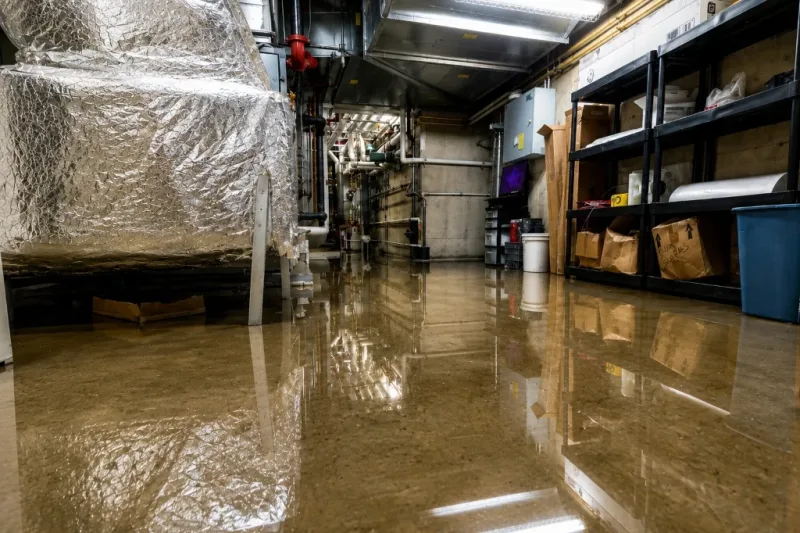
Why fire sprinkler system discharges represent the most destructive pressurized clean-to-black water transitions in commercial real estate.
Operating under 150–175 PSI across Downtown Dallas and Uptown office towers, an activated pendant sprinkler discharges 40 to 60 gallons per minute of high-velocity water into commercial suites, dropping 900+ gallons in 15 minutes.
Gravity pulls water through floor penetrations, bus ducts, telecom conduits, and elevator hoistways, triggering a ten-floor deluge. Demands immediate response from our commercial water damage restoration fleet.
Standing water dormant in black steel risers for years turns into a foul, dark sludge of oxidized iron, machine cutting oils, and propylene glycol. Stains modular office furniture, millwork, and executive carpeting instantly.
Upon contact with plenum dust and soil, water becomes Category 3 blackwater. Our water damage extraction crews deploy from our Restore Crest headquarters to halt microbial growth.
High-rise commercial properties across Dallas—from the Bank of America Plaza to corporate towers in Las Colinas—utilize massive vertical booster pumps to sustain high operating pressures on upper floors. When a mechanical rupture occurs, this intense pressure drives water behind fire-rated drywall assemblies and through electrical conduits with destructive hydraulic force.
Wet-pipe sprinkler lines remain dormant for extended intervals between NFPA 25 inspections. Discharged water carries pungent anaerobic odor, oily machining compounds, and heavy iron particulate that permanently discolors commercial upholstery, executive millwork, and archival paper records if not immediately extracted under specialized cleaning chemistries.
Commercial concrete slabs are penetrated by hundreds of vertical utility runs: telecommunication conduits, high-voltage bus ducts, plumbing chases, and elevator hoistways. Gravity pulls pooled sprinkler water down these structural pathways, creating multi-floor deluge cascades that compromise tenant operations across several building stories simultaneously.
Understanding the mechanical, environmental, and human factors that precipitate commercial deluge emergencies.
During severe Arctic polar vortex events across the DFW Metroplex, outdoor temperatures plummet below freezing for consecutive days. Uninsulated exterior wall cavities, unheated commercial parking garages, loading docks, and poorly insulated roof plenum spaces expose branch piping to freezing temperatures. Expanding ice blocks create immense radial hoop stress, splitting steel pipes or cracking ductile fittings that burst violently once building heat returns. Review our emergency protocols for burst pipe cleanup in Dallas.
In distribution centers along I-635, logistics hubs near DFW Airport, and corporate tenant renovation sites in Uptown, warehouse forklifts, high-reach scissor lifts, and contractor ladders frequently collide with exposed pendant sprinkler heads. Shearing the fragile deflector or fracturing the heat-sensitive glass bulb initiates instantaneous full-bore discharge at line pressure. Immediate isolation of building control valves is critical to prevent thousands of gallons of inundation.
Commercial sprinkler heads are engineered with precise liquid-filled glass bulbs (rated at 135°F, 155°F, or 175°F) or fusible solder links. When industrial heat guns, temporary construction space heaters, or failed commercial HVAC air handlers discharge superheated air directly onto sprinkler heads, thermal expansion fractures the glass ampoule without any actual fire event, releasing hundreds of gallons of oily water into occupied tenant office suites.
Within stagnant wet-pipe sprinkler systems, anaerobic bacteria—including sulfate-reducing bacteria (SRB) and acid-producing bacteria (APB)—colonize internal steel surfaces. These microbes metabolize iron and sulfur, generating localized pinhole corrosion pits beneath protective tubercle deposits. Eventually, the weakened pipe wall suffers catastrophic blow-out under standard hydrostatic pressure, spraying rust sludge into finished spaces.
Rapid valve closures, city water main pressure fluctuations, or sudden fire pump testing cycles can generate severe hydraulic shock waves (water hammer). These supersonic pressure spikes can momentarily exceed 300 PSI, causing threaded mechanical couplings, victaulic grooved fittings, and older branch elbows to decouple violently in ceiling plenums. When overhead piping fails, saturated ceiling materials require our specialized ceiling water damage repair specialists.
Even when a fire sprinkler system functions successfully by suppressing a localized kitchen blaze or electrical flare-up, the resulting water volume often inflicts ten times more physical property destruction than the fire itself. The combination of structural combustion soot and hundreds of gallons of suppression water requires a coordinated response uniting water extraction and certified fire and smoke damage restoration.
Engineered electrostatic containment and desiccant vapor extraction protocols for corporate high-tech facilities.
For major enterprises located along the Dallas North Tollway, corporate headquarters in Plano, and financial institutions in Downtown Dallas, physical office contents pale in comparison to the financial value of IT network infrastructure. When a sprinkler line ruptures above or adjacent to an Intermediate Distribution Frame (IDF) closet, Main Distribution Frame (MDF) server room, or corporate data facility, downtime costs escalate at thousands of dollars per minute.
Water intrusion in server environments presents severe, non-linear threats. Modern corporate server racks house high-density blade servers, storage area networks (SAN), and uninterruptible power supply (UPS) batteries operating at high voltages. Even if liquid water does not directly pour onto server chassis, the atmospheric humidity inside the flooded suite spikes to 100% relative humidity (RH). When warm, moisture-laden air is drawn through server cooling fans, micro-condensation forms across internal printed circuit boards (PCBs). This condensation combines with sulfur and chlorine compounds carried by sprinkler water to form corrosive electrolytic films that short-circuit delicate microprocessors and etch gold-plated connector pins.
At Restore Crest, our commercial emergency response team executes an engineered data preservation protocol designed to isolate and protect mission-critical technology assets:
Server rooms utilize raised access flooring with hollow sub-plenums housing power whips, data cabling, and cold-aisle HVAC airflow. We deploy specialized low-clearance extraction wands and submersible micro-pumps to evacuate pooled water from sub-floor plenums before it reaches low-mounted Power Distribution Units (PDUs).
We construct anti-static flame-retardant poly barriers around server enclosures. Industrial HEPA 500 air scrubbers equipped with activated carbon chemisorption filters capture airborne black water aerosols, rust dust, and particulates, preventing contamination of cooling fan intakes.
Standard refrigerant dehumidifiers cannot achieve the deep moisture depression needed to prevent electronic corrosion. We route dry air from trailer-mounted desiccant dehumidifiers directly into server rooms, reducing relative humidity below 30% and Grains Per Pound (GPP) below 20 to desiccate ambient air safely without static build-up.
If sprinkler water soaks hard-copy corporate legal records, architectural drawings, or magnetic backup media, our team initiates immediate on-site blast freezing followed by vacuum freeze-drying sublimation through our emergency pack-out and content restoration service.
By stabilizing server environments within the first two hours of incident notification, our certified large-loss specialists prevent hundreds of thousands of dollars in catastrophic server replacements and data loss. Learn more about our specialized industrial qualifications on our Restore Crest corporate team page.
Immediate high-stakes operational steps for building engineers, property managers, and security directors during a sprinkler activation.
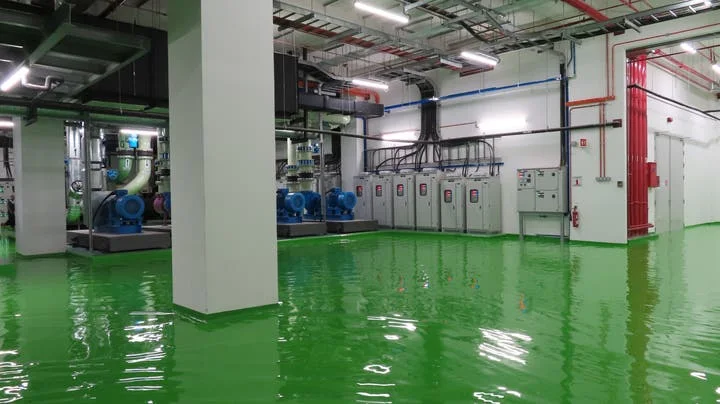
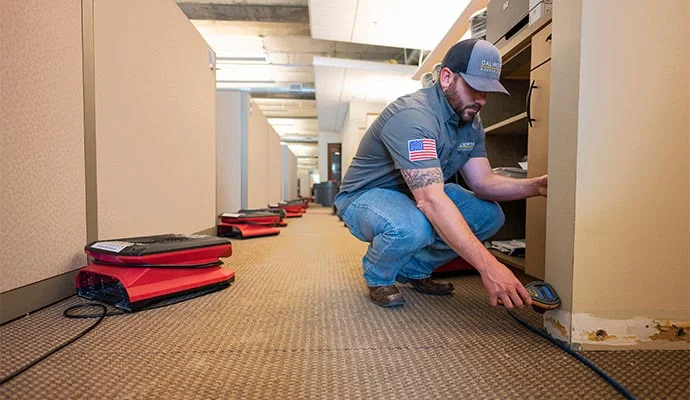
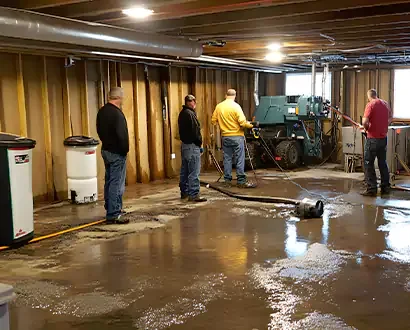
Authentic documentation of industrial extraction, multi-level staging, and trailer desiccant equipment on Dallas commercial properties.
Engineered to minimize commercial downtime, protect corporate tenant assets, and strictly adhere to IICRC S500 commercial drying standards.
Upon on-site arrival within 45 minutes, our certified large-loss incident commander coordinates directly with Dallas Fire-Rescue and facility engineering staff. We visually verify that the zone control OS&Y or butterfly valve is fully seated and that the system main drain is open. We immediately conduct an arc-flash hazard assessment, verify electrical lock-out/tag-out on flooded distribution panels, and establish portable auxiliary lighting and generator power.
Standing water is evacuated simultaneously across all affected floors. We deploy heavy-duty truck-mounted high-flow extraction units paired with commercial weighted extraction rovers. For lower-level mechanical rooms or elevator pits, submersible trash pumps discharge up to 4,500 gallons per hour directly into designated municipal sanitary sewer drain points, preventing deep slab absorption and water table saturation.
To halt cross-floor moisture migration, we establish heavy-duty 6-mil flame-retardant poly containment barriers around elevator hoistway openings, stairwells, and utility chases. We install HEPA 500 air scrubbers in negative pressure configuration to isolate black sprinkler odor, airborne particulate, and volatile rust aerosols from adjacent non-affected office suites, enabling non-impacted business divisions to continue operations.
Commercial office towers contain dense building assemblies: poured concrete over corrugated metal decks, steel stud partitions, and multiple drywall layers. Standard refrigerant dehumidifiers fail in these high-volume environments. Restore Crest stages trailer-mounted 5,000 to 10,000 CFM desiccant dehumidifiers powered by mobile diesel generators. Lay-flat ducting delivers ultra-low dewpoint air (under 15 GPP) that draws deep bound moisture out of structural slabs.
Oily, rust-laden sprinkler discharge permanently contaminates porous ceiling tiles and saturated commercial carpet padding. Our technicians perform precision flood cuts on non-salvageable drywall below the water line on metal framing studs, remove contaminated insulation, and apply EPA-registered botanical antimicrobials to structural steel and concrete surfaces, completely neutralizing stagnant anaerobic odors without introducing toxic VOCs.
Our IICRC-certified master restoration leads perform comprehensive twice-daily moisture mapping across all structural assemblies. We conduct calcium chloride and radio-frequency concrete moisture impedance tests to verify that subfloors have returned to dry equilibrium baselines. Facility leadership receives a complete, signed digital psychrometric clearance package certifying that the property meets all municipal Dallas building codes and IICRC S500 standards.
We eliminate corporate financial uncertainty with binding, itemized flat-rate quotes approved by facility leadership prior to work commencement.
Commercial property managers and corporate directors require absolute budgetary predictability. We provide transparent, itemized line-item flat rates covering equipment mobilization, labor, and drying cycles.
"When a pressurized fire sprinkler line bursts on the twelfth floor of an office tower, you aren't dealing with a domestic leak—you're dealing with a hydraulic crisis. Stagnant black water under 150 PSI migrates through core penetrations, elevator shafts, and electrical bus ducts, threatening millions in tenant assets and corporate revenue. My team arrives within 45 minutes equipped with high-volume industrial extractors and trailer-mounted desiccant systems capable of stabilizing 100,000 square feet without shutting down your entire facility. We provide transparent, upfront itemized flat rates before our equipment turns on."
Practical, authoritative engineering answers for commercial facility directors, property managers, and corporate safety engineers.
Wet-pipe fire sprinkler systems store municipal water inside black carbon steel or ductile iron piping for months or years under stagnant, anaerobic conditions. Over time, internal pipe scale, pipe-threading cutting lubricants, and rust particles accumulate. Anaerobic bacteria, such as sulfate-reducing bacteria, flourish within this dormant environment, generating hydrogen sulfide compounds that produce a pungent rotten-egg odor. When discharged under 150 PSI, this stagnant slurry ejects as a dark, oily liquid that rapidly stains commercial carpets and acoustic ceiling tiles. Our crews apply specialized EPA-registered botanical antimicrobials and biological odor counteracting agents to neutralize these contaminants completely.
We guarantee commercial on-site arrival in under 45 minutes across Dallas County and the DFW Metroplex. We maintain pre-staged emergency response trailers equipped with heavy-duty extraction units, commercial desiccant dehumidifiers, lay-flat ducting, and submersible pumps positioned along primary commercial transportation corridors including the Dallas North Tollway, Central Expressway US-75, and Stemmons Freeway I-35E. When you call our 24/7 commercial emergency hotline at +1 (214) 491-5611, an on-duty large-loss operations supervisor immediately authorizes dispatch.
Yes. Our commercial methodology is engineered around phased operational containment. We erect heavy-duty 6-mil poly barrier walls fitted with negative air HEPA scrubbers to isolate the affected flood zones from adjacent work areas. By isolating elevator banks, stairwells, and hallways, non-impacted corporate departments, retail operations, or medical suites can continue daily business operations safely without exposure to noise, odors, or physical safety hazards. We also schedule high-noise extraction or selective strip-out during off-peak evening or overnight hours upon request.
Standard Low Grain Refrigerant (LGR) dehumidifiers condense ambient moisture through refrigeration coils. While effective in residential spaces, they struggle in large commercial structures with high ceiling volumes, dense concrete subfloors, and multi-layer drywall partitions. Trailer-mounted industrial desiccant dehumidifiers utilize chemical adsorption rotors (silica gel) that remove moisture directly from the air regardless of ambient temperatures. They deliver ultra-dry air with grains per pound (GPP) below 15 and relative humidity under 20%, creating extreme vapor pressure gradients that rapidly draw deep bound moisture out of structural concrete and metal stud cavities.
Elevator shafts act as vertical flumes during commercial water disasters. Discharged sprinkler water flows across the corridor floor, enters hoistway door gaps, and pours down into the elevator pit. Water damages traveling electrical cables, door interlocks, car top electronics, and counterweight buffers. If water reaches the bottom pit, it submerges hydraulic cylinders, governor tension sheaves, and safety switches. Our crews immediately coordinate with your elevator maintenance contractor, stage threshold dams to halt further water entry, and deploy submersible pumps to dewater elevator pits before corrosion compromises mechanical components.
We treat IT environments as specialized cleanrooms. Our specialists deploy anti-static poly shrouds over server racks, install HEPA 500 air filtration units to remove airborne rust and water particles, and pump dry desiccant air into server rooms to depress relative humidity below 30%. In raised access flooring environments, we open select perforated floor tiles and utilize micro-extraction wands to pull pooled water out of cable trays and sub-plenum air runs before delicate wiring or low-voltage power distribution units are damaged.
In many commercial installations, yes. Unlike residential wood studs, commercial framing utilizes galvanized light-gauge steel studs that do not rot or swell. If clean water or early-stage sprinkler water has wicked into gypsum board, we can inject desiccated warm air directly into wall cavity bays through discrete holes drilled behind rubber cove base. However, if the water contains heavy black iron sludge, cutting oil, or insulation was soaked inside the wall cavity, selective precision flood cuts (typically 12 to 24 inches from the floor) are necessary to remove contaminated materials and sanitize the cavity.
Poured concrete commercial floor slabs absorb massive quantities of water through capillary porosity. Reinstalling vinyl composition tile (VCT), engineered wood, or commercial carpet over a wet slab traps moisture, causing adhesive saponification, mold blooms, and tile tenting. We verify slab dryness using non-destructive radio-frequency impedance meters followed by ASTM F2170 in-situ relative humidity probes drilled into the concrete slab. We only issue structural drying clearance when internal slab relative humidity drops below manufacturer adhesive thresholds (typically below 75% to 80% RH).
Dallas commercial buildings are frequently designed for extreme summer heat rather than sub-freezing Arctic polar vortex blasts. Sprinkler branch lines routed above loading docks, near exterior uninsulated curtain walls, or in ventilated parking garages are vulnerable to freezing when temperatures drop below 32°F. As water freezes inside rigid steel pipe, it expands by approximately 9% in volume. Because water cannot compress, the expanding ice exerts over 25,000 PSI of internal hydraulic force, fracturing pipe fittings or splitting longitudinal seam welds. When the ice thaws, full municipal riser pressure discharges unrestricted.
We provide commercial clients with 100% transparent, itemized flat-rate quotes prior to deploying heavy drying equipment. Upon our 45-minute on-site arrival, our lead field operations director performs a complete thermal scan, square-footage assessment, and equipment requirement calculation. We present a binding, line-item proposal specifying exact extraction costs, 24-hour trailer desiccant equipment rates, containment setup, and antimicrobial applications. Your facility management team reviews and signs off on the scope with zero hidden fees or unexpected billing surprises.
Mobile large-loss response rigs positioned strategically near major commercial corridors for guaranteed under 45-minute arrival.
Every passing minute of standing sprinkler water increases structural damage to ceilings, elevator shafts, electrical panels, and corporate assets. Speak directly with our on-duty Restore Crest Dallas commercial operations director right now. We arrive in under 45 minutes with industrial extraction rovers and trailer desiccant equipment.
Complete the form below. Our commercial large-loss operations director will contact you immediately.